Kenyan coffee beans are high-grown, washed Arabica, mostly from smallholder farms around Mount Kenya, and they are among the most sought-after coffees in the world for their bright, juicy acidity and blackcurrant, berry and citrus flavours. They are graded by bean size (AA, AB, PB and so on), with AA the largest and best known. We sell Kenyan coffee beans green as traceable single-origin lots, and Kenyan-style AA/AB East African Arabica for blends, packed in 60 kg jute bags and shipped worldwide.
If you roast specialty coffee, or want a standout single origin that customers remember, Kenya is hard to beat. This guide covers what you need to know before buying: the regions, the varieties (SL28, SL34, Ruiru 11, Batian), how washed Kenyan coffee is processed, what AA, AB and PB really mean, when the harvest arrives, what the 2026 market looks like, how to roast it and how to order from us. Figures are linked to their sources so you can check them.
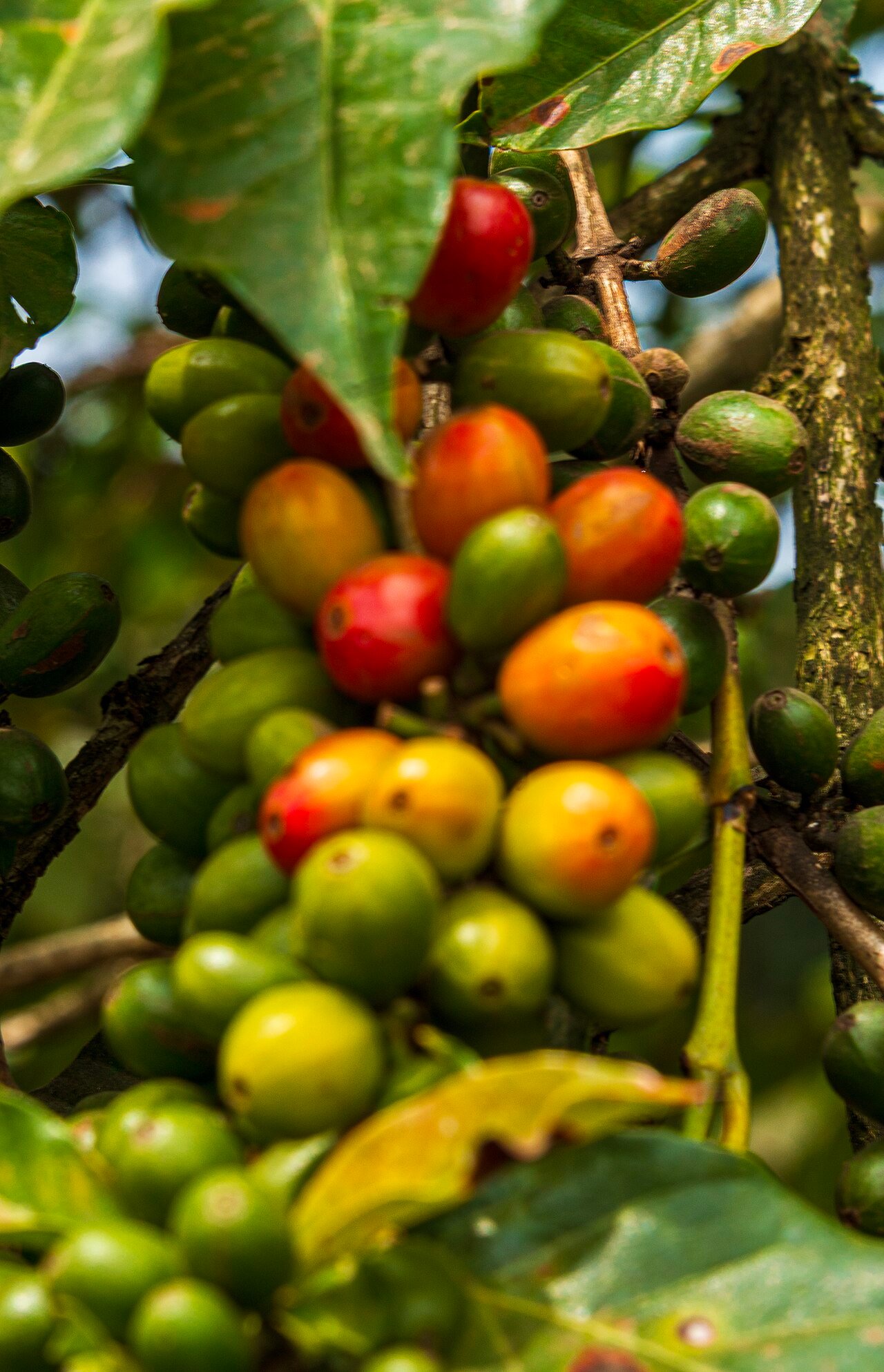
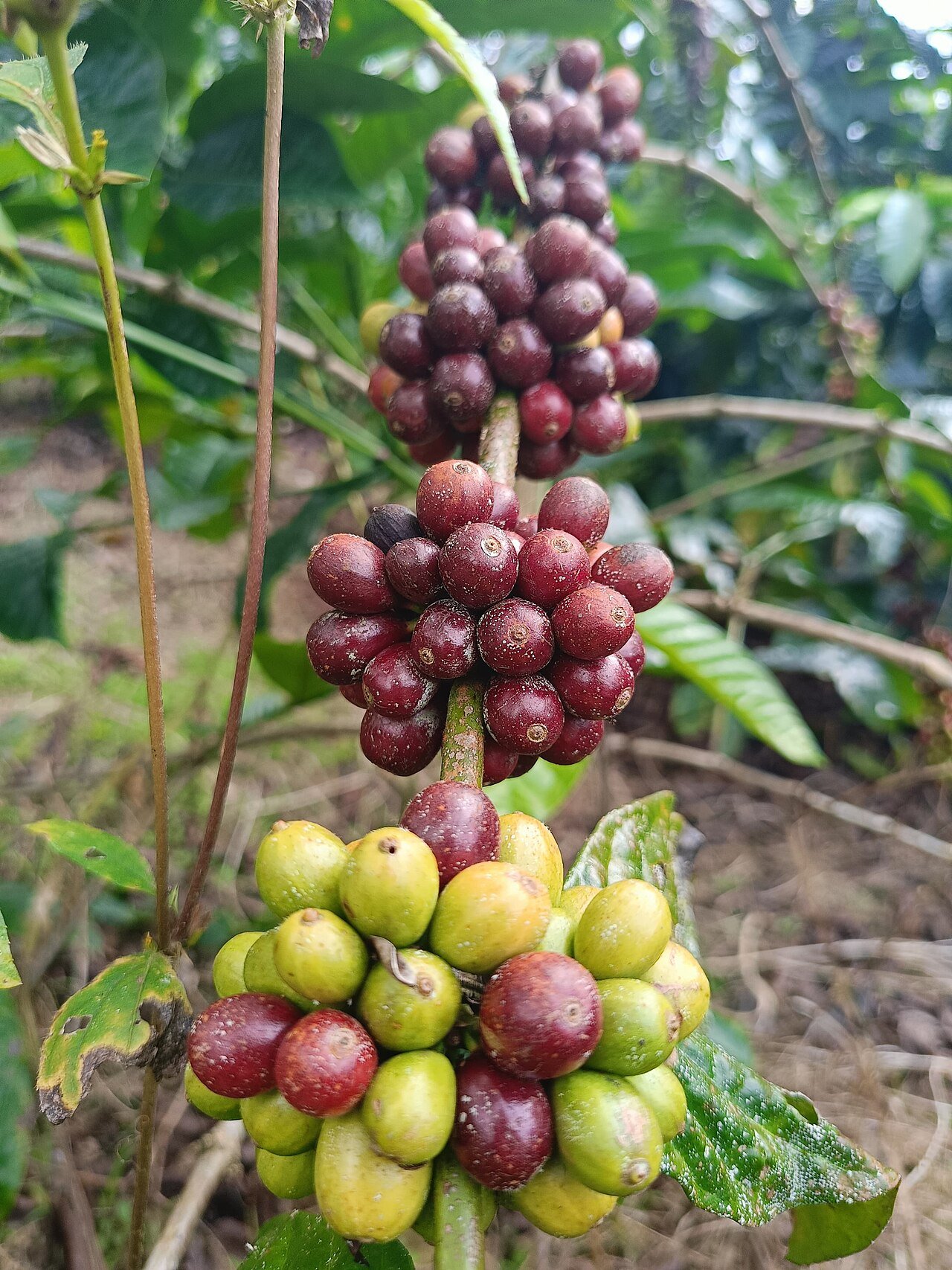
Ripe coffee cherries on an estate in Kiambu, Kenya. Photo: Daniel Case, CC BY-SA 4.0, via Wikimedia Commons.
Table of Contents
Table of Contents
What are Kenyan coffee beans?
Kenyan coffee beans are coffee grown in Kenya and exported as green (unroasted) beans. Almost all of it is Arabica, grown at high altitude on volcanic soils, and almost all of it is washed. Kenya is a small producer by volume. A large US importer’s review puts Kenya at about 850,000 60 kg bags in 2025/26, roughly 0.48% of world production, ranking it around 25th by volume.
What Kenya lacks in volume it makes up for in reputation. Ask a room of specialty roasters which origin has the most distinctive cup, and Kenya will be near the top of most lists.
Most Kenyan coffee is grown by smallholders. The same review says roughly 80% of Kenyan coffee is sold through cooperatives, with the rest from cooperatives and individual estates. Coffee from many small farms is delivered as cherry to a local wet mill, called a “factory” in Kenya, where it is processed and dried.
If you are new to Arabica in general, our guide to Arabica coffee beans covers the basics, and Arabica vs Robusta explains the two species.
Kenyan coffee beans at a glance
- Species: almost all Arabica.
- Main regions: Nyeri, Kirinyaga, Murang’a, Kiambu, Embu and Meru around Mount Kenya.
- Processing: mostly fully washed at cooperative factories.
- Varieties: SL28, SL34, Ruiru 11, Batian.
- Grades: by size and density: AA, AB, PB, C, E, TT, T.
- Harvest: main crop October to December; smaller fly crop mid-year.
- 2026/27 output: forecast at about 950,000 bags.
- EUDR: classed as low risk.
A short history of Kenyan coffee
Coffee is a relative newcomer in Kenya compared with Ethiopia next door. One account has it arriving in 1893, when French Holy Ghost Fathers brought trees from Réunion Island, with British settlers expanding growing around 1900. A Coffee Act in 1933 created the Coffee Board and brought coffee sales back to Kenya.
In the 1930s, Scott Agricultural Laboratories in Nairobi selected the SL varieties that made Kenyan coffee famous. After independence, smallholder cooperatives took over a growing share of production. According to the same source, about 70% of Kenyan coffee is produced on small farms that control about 75% of the land under coffee. That smallholder-and-factory structure is still how most Kenyan coffee beans reach the market today.
Why roasters buy Kenyan coffee beans
- A cup people remember. Bright, juicy acidity with blackcurrant, blackberry, grapefruit and tomato-like savoury notes. Very few origins taste like a good Kenya.
- A premium single origin. Kenya AA is one of the best-known names in coffee. It sells at a premium on café menus and retail shelves.
- Traceability. Many Kenyan lots are named after the factory (wet mill) that processed them, so you can tell a real origin story.
- Blend lift. A small share of Kenyan coffee adds brightness and fruit to a blend that would otherwise taste flat.
- Clean, consistent processing. Kenya’s washed coffees are known for clarity.
- Low EUDR risk. Useful if you sell into the European Union (see below).
Our guide to single origin coffee beans explains how to build a single-origin range, and Kenyan coffee beans are often the centrepiece of one.
How Kenyan coffee beans taste
Typical trade descriptions for good washed Kenyan coffee:
- Acidity: high, bright and juicy, often described as winey or phosphoric.
- Fruit: blackcurrant, blackberry, red currant, plum, grapefruit, lemon.
- Savoury notes: a tomato-like or savoury sweetness that is a Kenyan signature.
- Sweetness: brown sugar, caramel, sometimes molasses.
- Body: medium to full, syrupy in the best lots.
These are general descriptions; every lot is different. Always cup a sample before buying. Our guide to coffee cupping explains how to score samples properly.
Where Kenyan coffee beans are grown
Most Kenyan coffee grows in the central highlands around Mount Kenya, with smaller areas in the west and the Rift Valley.
Nyeri
Probably the most famous Kenyan region for specialty coffee, on the slopes of Mount Kenya and the Aberdares. Red volcanic soil and mostly smallholder production. Nyeri lots are known for intense blackcurrant and bright acidity.
Kirinyaga
South-east of Mount Kenya, also on volcanic soil. Kirinyaga coffees are often very sweet and juicy, with complex fruit.
Murang’a
A large smallholder region; the importer review notes it has up to 100,000 smallholders. Balanced, sweet coffees with good body.
Kiambu
Closer to Nairobi, and home to many of Kenya’s large, often multinational-owned estates, which focus on higher-yield, more mechanised production.
Embu, Meru and Kirinyaga’s neighbours
East of Mount Kenya. Increasingly well known for clean, bright, fruit-forward lots.
Western Kenya and the Rift Valley
Smaller areas such as Kisii, Mount Elgon (on the Ugandan border) and parts of the Rift Valley. Government expansion programmes now target the central, eastern and Rift Valley regions.
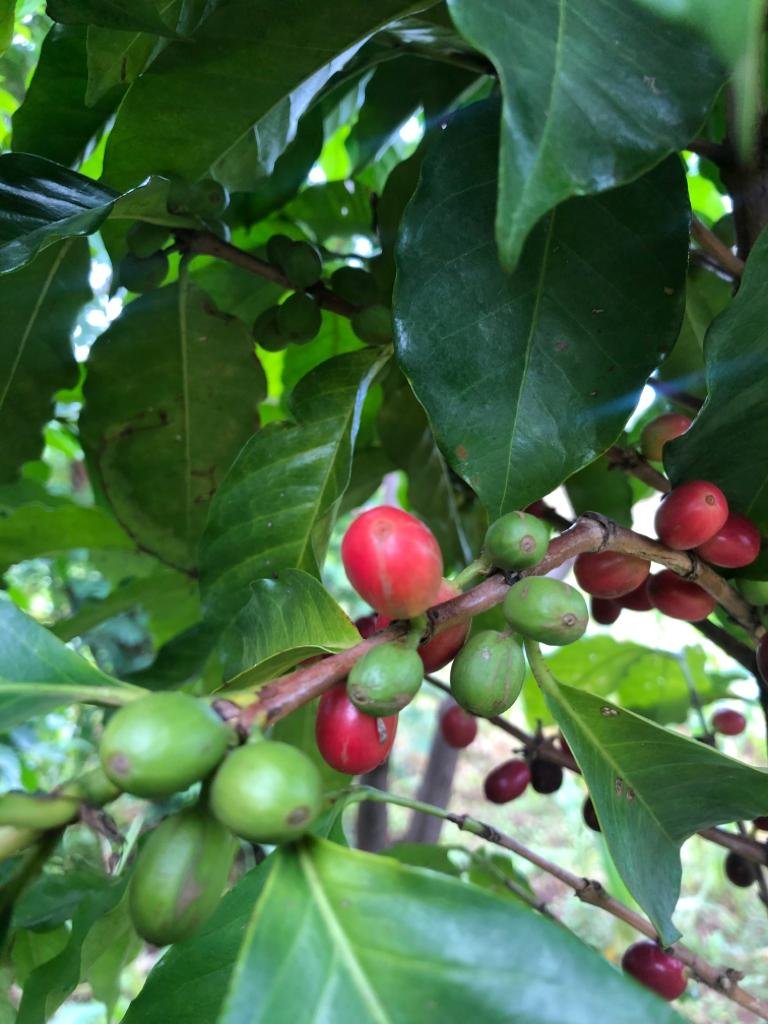
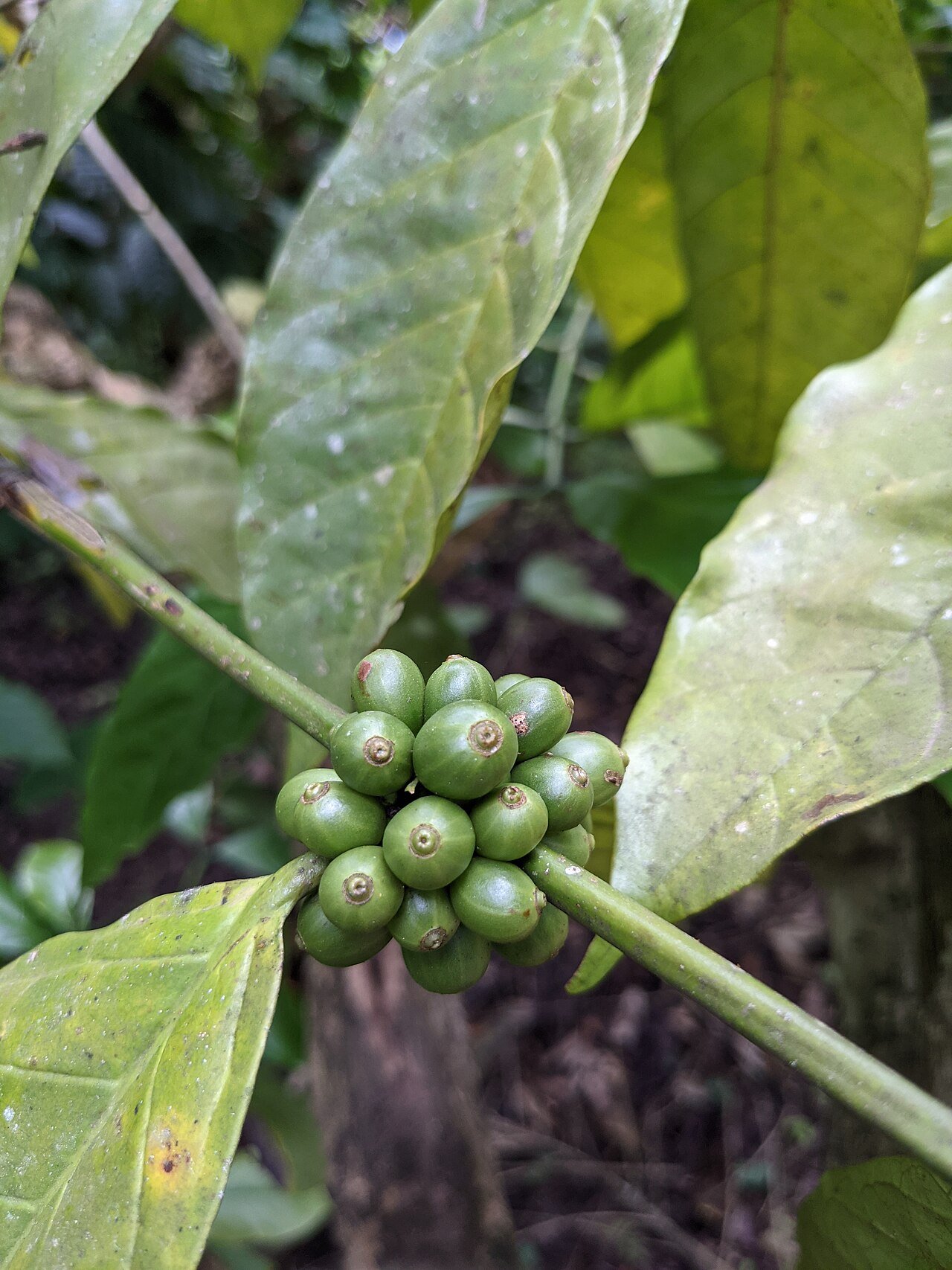
Coffee berries on a small farm in Kisii. Photo: Kihara wa kigo, CC BY-SA 4.0, via Wikimedia Commons.
Kenyan coffee varieties: SL28, SL34, Ruiru 11 and Batian
Variety is a big part of why Kenyan coffee beans taste the way they do.
- SL28. The most famous. World Coffee Research records that it was selected at Scott Agricultural Laboratories in Kenya in 1935 from a population called Tanganyika Drought Resistant. It has very good cup quality potential and is drought tolerant, but is susceptible to the major coffee diseases, including leaf rust and coffee berry disease.
- SL34. Another Scott Laboratories selection, also prized for cup quality but susceptible to disease and climate stress.
- SL14. Selected in the late 1930s and important in both Kenya and Uganda.
- Ruiru 11. A hybrid bred for productivity and disease resistance, widely planted from the 1980s. It has a weaker specialty reputation than the SLs.
- Batian. Released in 2010, combining disease resistance with better cup quality. The importer review describes it as currently the most-planted tree in the country.
- K7 and Kent. Older varieties still found on some farms.
Many Kenyan lots are a mix of SL28, SL34, Ruiru 11 and Batian from the same factory. Lots described as pure SL28 or SL28/SL34 often carry a premium.
How Kenyan coffee is processed
Most Kenyan coffee beans are fully washed at a factory (wet mill). The traditional Kenyan method, often described as double fermentation, goes roughly like this:
- Smallholders hand-pick ripe cherry and deliver it to the factory the same day.
- Cherries are sorted and floated to remove unripe and damaged fruit.
- The cherries are pulped and the parchment coffee is fermented in tanks to loosen the mucilage.
- The coffee is washed and often soaked again in clean water, then washed in channels that also grade beans by density.
- Parchment is sun-dried on raised beds, usually for one to three weeks, then rested.
- The dried parchment goes to a dry mill to be hulled, graded by size and density, and prepared for sale.
This careful washing and density sorting is a big part of the clarity Kenya is known for. Some factories now also produce naturals and honey-processed lots, usually in small amounts. For a broader look at methods, see our guide to coffee processing methods.
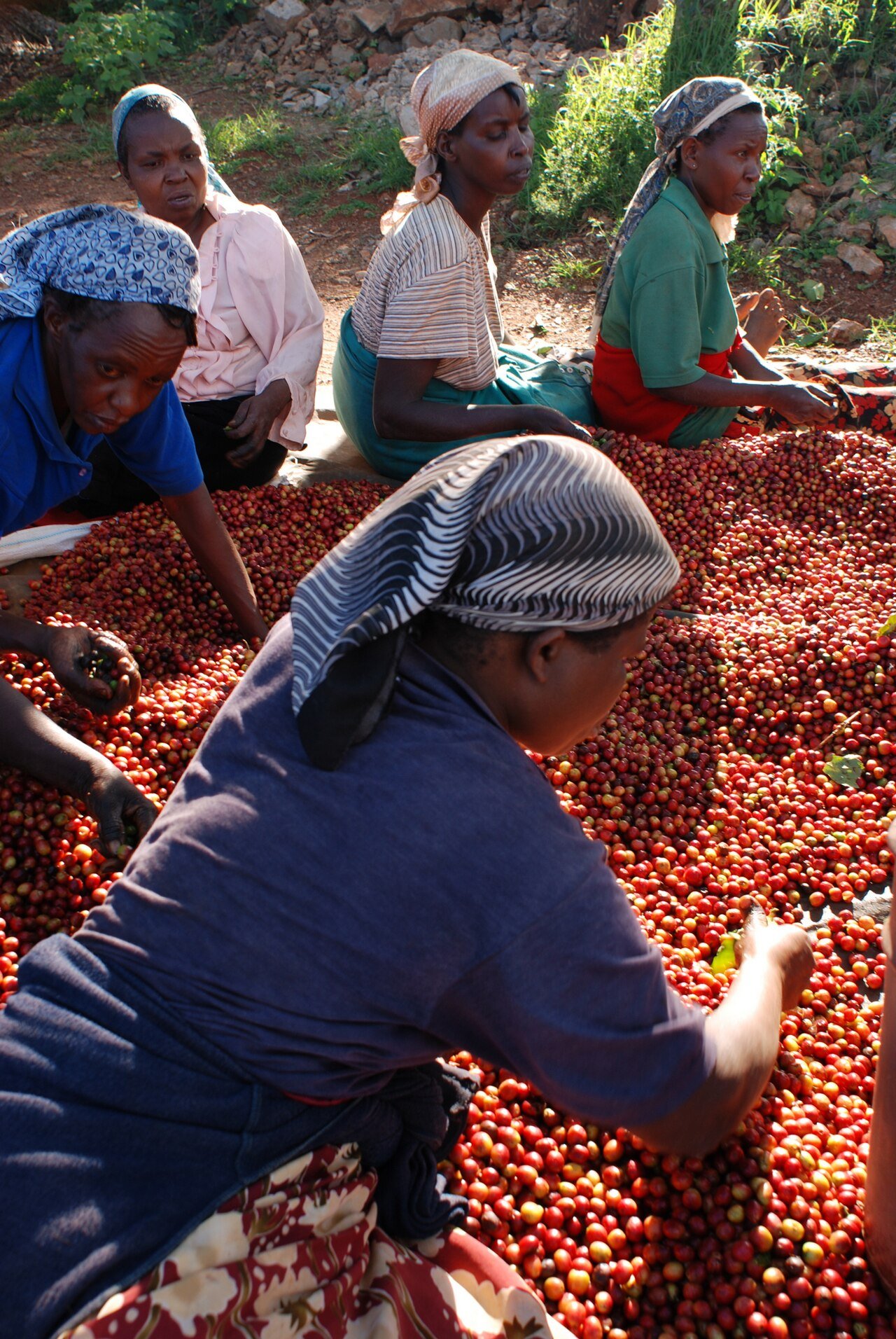
Sorting coffee cherries in Kenya. Photo: Kamweti wa Mutu, CC BY-SA 4.0, via Wikimedia Commons.
AA, AB, PB and other Kenyan grades explained
Kenyan coffee beans are graded mainly by size, with some grades also separated by density. A Kenyan coffee importer’s grade guide gives these definitions:
| Grade | What it means | Typical use |
|---|---|---|
| AA | Screen 18, over 7.2 mm; large, dense beans | Premium single origin |
| AB | Screen 16 to 17, about 6.8 mm | Single origin, quality blends |
| PB | Peaberry, single rounded beans, around screen 17 | Specialty single origin |
| E | “Elephant” beans, screen 21 and up | Niche, often mixed with AA |
| C | Screen 12 to 14, smaller beans sorted from AB | Blends |
| TT | Screen 16 to 20 but lower density | Blends, commercial |
| T | Smallest, under screen 12 | Commercial |
| MH / ML | Mbuni (natural) heavy and light | Commercial, local use |
Two important points. First, size is not the same as quality. An excellent AB lot can taste better than an average AA. Second, Kenyan lots are also given cup quality classes when they are sold, and many buyers pay more attention to the cupping score and factory than to the size grade. Our guide to coffee bean grading explains screen sizes and defects in more depth.
How Kenyan coffee is sold
Kenya has an unusual marketing system. Much of the coffee is sold through the Nairobi Coffee Exchange, a weekly auction where licensed marketing agents offer lots and licensed dealers bid on behalf of overseas buyers. Kenya also allows direct sales, where farmers or cooperatives sell to buyers outside the auction.
The country has been reforming its coffee sector, including new legislation on oversight and on how quickly farmers are paid. Auction prices move a lot: one market report noted that Nairobi Coffee Exchange prices fell 28.4% from October 2025 to US$268.77 per 50 kg bag in April 2026.
What this means for you: unless you have a licensed dealer in Kenya, you will normally buy Kenyan coffee beans through an exporter or importer who buys at the auction or directly and ships to you. That is what we do. Our guide to choosing a green coffee supplier and our page on working with a coffee exporter explain what to look for.
Harvest calendar for Kenyan coffee beans
Kenya has two harvests a year:
- Main crop: harvested mainly October to December. This is the larger crop and usually the higher quality.
- Fly crop: a smaller second harvest in late spring and early summer.
After harvest, coffee is processed, dried, rested, milled, sold and shipped. The same importer says fresh main-crop coffee typically reaches its US warehouse between May and August, and fly-crop coffee from November to March. Timing to your port will differ, but the pattern is similar: main-crop Kenyan coffee beans arrive in consuming markets around the middle of the following year.
The best lots sell early. If you want a particular factory or AA lot, ask for pre-shipment samples and book in the first half of the year. Our guide to the coffee harvest season shows how Kenya fits with other origins.
The Kenyan coffee market in 2026
- Production up: a USDA report forecasts Kenya’s 2026/27 output at 950,000 bags, about 57,000 tonnes, up 12%.
- Exports up: forecast at 940,000 bags (about 56,400 tonnes), up from about 50,400 tonnes.
- Revenue doubled: Kenya’s coffee export revenue rose from 26.1 billion to 52.05 billion Kenyan shillings between 2021 and 2025, according to Kenya National Bureau of Statistics figures cited in the same report.
- Where it goes: the United States is the top destination, per the importer review, followed by European buyers. Local consumption is small, around 62,000 bags.
- Investment: state-backed programmes are distributing seedlings and fertiliser to expand production in the central, eastern and Rift Valley regions.
What this means for buyers: more Kenyan coffee should reach the market in 2026/27, but Kenya is still a small origin with strong demand for its top lots. Good AA and PB lots from well-known factories will still sell early. For how green coffee prices are set, see our guide to green coffee prices.
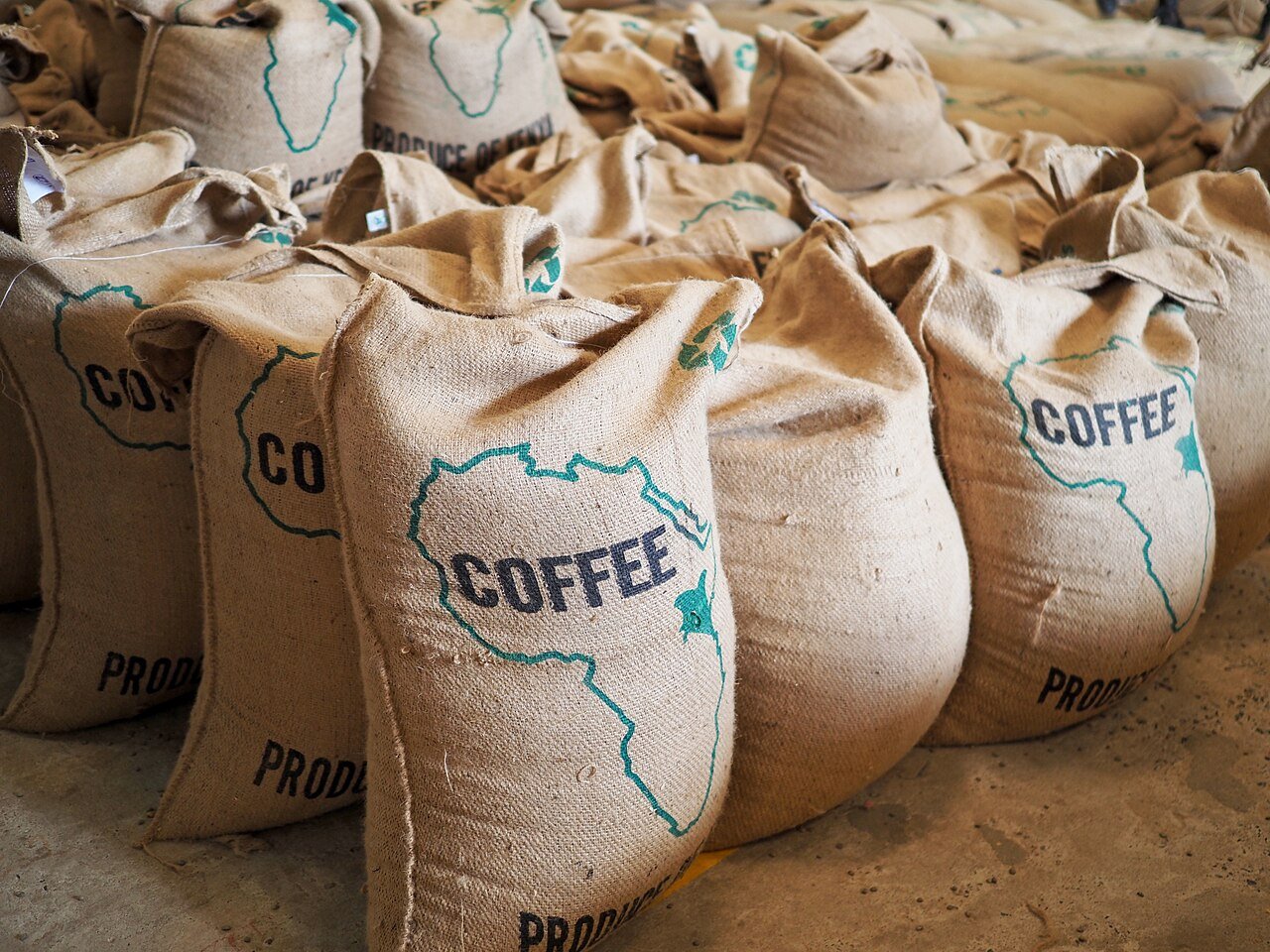
Bags of Kenyan coffee. Photo: Bex Walton, CC BY 2.0, via Wikimedia Commons.
EUDR status: Kenya is classed as low risk
The EU Deforestation Regulation applies to larger operators and traders from 30 December 2026, and to very small businesses from 30 June 2027. Kenya has been classified as a low-risk country under the regulation, which means simplified checks. You still need geolocation and traceability data for each lot you place on the EU market. Because many Kenyan lots are traceable to a named factory, that data is often easier to get than for some other origins, but ask your supplier what comes with each lot.
Roasting Kenyan coffee beans
General guidance roasters commonly follow, not a fixed profile:
- Dense, high-grown beans. Kenyan coffee usually takes heat well early in the roast.
- Light to medium suits most lots. The fruit and bright acidity are the point. Dark roasts flatten them.
- Do not under-develop. Very light, under-developed Kenya can taste sharp and sour rather than bright. Aim for enough development to round the acidity.
- AA and AB roast differently. Bigger AA beans may need a little more time than AB. Do not mix grades in one batch.
- Peaberries roast evenly. Their round shape rolls well in the drum, and many roasters like how evenly PB lots develop.
- Rest it. Light-roasted Kenyan coffee often tastes best after several days of rest.
Our guide to roasting green coffee beans covers roast stages and development in detail.
Best uses for Kenyan coffee beans
Single-origin filter
The classic use. Pour-over, batch brew and AeroPress show off Kenya’s fruit and acidity best.
Single-origin espresso
Bright, juicy and intense. Not for everyone, but a strong choice for a guest espresso. Our guide to coffee beans for espresso covers dialling in brighter coffees.
Blend lift
A 10% to 30% share of Kenyan coffee adds brightness and fruit to a chocolatey Brazil- or Robusta-based blend.
Cold brew
Kenyan cold brew can be fruity and refreshing, with much of the sharp acidity softened by cold extraction. See coffee beans for cold brew.
Our Kenyan coffee beans
We sell Kenyan coffee beans in two ways: as traceable single-origin lots within our Africa Arabica range, and as part of our East African Arabica in Kenyan-style AA/AB grades for blends.
Kenyan single-origin lots

Kenya is one of the countries in our traceable Africa Arabica range. Tell us the grade (AA, AB or PB), region and volume you need and we will send offers and samples of the Kenyan lots we can supply that season.
Africa Arabica coffee beans, short spec:
- Species: Coffea arabica (green beans)
- Origins: Ethiopia, Kenya, Uganda, Tanzania, Rwanda, Burundi
- Sold as: single-origin, traceable lots
- Altitude: 1,300 to 2,200 m
- Process: washed, natural or honey
- Screen: 15 to 18, plus PB
- Moisture: max 12.5%
- Cup: floral, fruity, bright, clean
- Packing: 60 kg jute bags
East African Arabica, AA / AB

If you want the bright, fruity East African style in AA/AB grades for blends, but do not need a named country on the bag, this is the better value.
African Arabica coffee beans, short spec:
- Species: Coffea arabica (green beans)
- Origin: East African highlands
- Altitude: 1,400 to 2,200 m
- Process: washed or natural
- Screen: 15 to 18 (AA / AB)
- Moisture: max 12.5%
- Cup: bright, fruity, floral, clean
- Packing: 60 kg jute bags
Which one should you choose? If you want to print “Kenya” on the bag and tell a factory-level story, go for the single-origin Kenyan lots. If you need a bright, fruity East African component for a blend and the exact country matters less than the cup and the price, the East African AA/AB is the practical choice. Many of our customers buy both: a named Kenyan coffee for the single-origin shelf, and East African AA/AB to brighten their house espresso. Either way, ask for samples first. Kenyan coffee beans vary a lot from lot to lot, and the only reliable way to choose is to roast and cup them yourself.
Browse all our Arabica coffee beans in one place.
Kenyan coffee beans vs other East African coffees
Buyers often weigh Kenya against its neighbours. A rough guide based on typical trade descriptions:
| Origin | Typical washed cup | Grading | Price position |
|---|---|---|---|
| Kenya | Juicy, blackcurrant, bright acidity, savoury sweetness | By size (AA, AB, PB) | Usually high |
| Ethiopia | Floral, citrus, tea-like; naturals very fruity | Grade 1 to 5 by defects and cup | Wide range |
| Uganda (Bugisu) | Sweet, balanced, chocolate and citrus | By size (AA, A, PB) | Usually lower |
| Tanzania | Bright, citrus, medium body | By size (AA, A, B, PB) | Moderate |
| Rwanda and Burundi | Red fruit, sweet, clean | By grade and screen | Moderate to high |
All of these are available through our Africa Arabica single-origin range, so you can cup a Kenya against an Ethiopian or a Rwandan before choosing. Our guides to Ethiopian green coffee beans and Ugandan coffee beans go deeper on those origins.
Blending Kenyan coffee beans with our other coffees
Kenyan coffee is often used on top of a heavier, chocolatey base. These are the coffees in our range that customers most often pair with it:



- Brazilian Robusta (Conilon): smooth, chocolate, nutty, low acid; screen 16/18 or 18/20.
- Indian Robusta: shade-grown, very clean, chocolate and nut; screen 17/18 or 18/20.
- Indonesia Robusta: heavy body, chocolate and cedar; screen 16/18 or 18/20.
- Ugandan Robusta: cocoa, earthy, mild spice; screen 15 to 18.
- Vietnam Robusta: sweet, rich, mild acidity; screen 16/18.
- African Robusta: strong, 2.2% to 2.7% caffeine; screen 16/18 or 18/20.
Starting blends to try:
- Bright espresso: 60% Brazilian Arabica or Conilon, 25% Kenyan AB, 15% Indian Robusta.
- Fruity house filter: 50% Kenyan AB, 50% a softer Ugandan or Latin American Arabica.
- All-African espresso: 40% Kenyan AB, 30% Ethiopian natural, 30% Ugandan Robusta.
See all our Robusta in the Robusta coffee beans category or on the full products page.
Which Kenyan grade fits your business?
Specialty roasters and cafés
AA or PB from a named factory, ideally with SL28/SL34 in the mix, for a headline single origin. AB from a good factory is often the best value for a regular menu Kenya.
Wholesale roasters
AB lots, or our East African AA/AB Arabica, give Kenyan-style brightness at a lower cost. Use them as a single origin for restaurants or as a blend component.
Blend and espresso programmes
Smaller grades such as C or TT, or East African AB, can add Kenyan brightness to blends without paying AA prices.
Private-label and retail brands
Kenya AA is one of the easiest coffees to sell on a retail bag. Consistency matters, so agree on a grade and cup profile and keep buying to that spec.
Main crop vs fly crop: does it matter?
Yes, it can. The main crop is larger and is usually where the best lots come from, because cherries ripen over a longer, steadier season. Fly-crop coffee is harvested from a smaller mid-year flowering. It is often perfectly good, sometimes excellent, but it tends to be less consistent and is usually cheaper.
Two practical tips. First, always ask which crop a lot comes from, because the same factory can taste noticeably different between the two. Second, fly-crop Kenyan coffee beans can be a smart way to keep a Kenyan coffee on your menu between main-crop arrivals, at a lower price, as long as you cup it first.
Telling the Kenyan story on your bag
Kenya is one of the easiest origins to market well, because the details are real and specific. Things you can usually say truthfully about a traceable Kenyan lot:
- The region, such as Nyeri or Kirinyaga, and often the factory name.
- That it was grown by smallholder members of a cooperative.
- The varieties, such as SL28 and SL34, if your supplier confirms them.
- That it was hand-picked and fully washed.
- The grade (AA, AB or PB) and what it means.
Avoid claims you cannot check, such as specific farmer names or prices paid, unless your supplier gives you that information in writing. A clear, honest origin story sells Kenyan coffee better than vague superlatives.
Disease, climate and why varieties are changing
The famous SL varieties have a weakness. World Coffee Research lists SL28 as susceptible to coffee leaf rust, coffee berry disease and nematodes. Coffee berry disease in particular has been a serious problem in Kenya’s wet highlands, and that is why researchers developed Ruiru 11 and later Batian, which resist it.
For buyers, this has two effects. First, more Kenyan coffee now contains Batian and Ruiru 11, and fewer lots are pure SL28/SL34. Second, the lots that are still mostly SL28/SL34 tend to carry a premium. Batian has a better cup reputation than Ruiru 11, and good Batian-heavy lots can cup very well. As always, judge the cup rather than the label.
Factories, cooperatives and traceability
Most Kenyan coffee beans come from smallholders who deliver cherry to a factory run by their cooperative society. One cooperative may run several factories, and each factory processes coffee from hundreds or thousands of farmers. Lots are usually named after the factory, such as “Kenya Nyeri [factory name] AA”.
That system is good news for traceability. You can usually tell your customers which factory and region a Kenyan lot came from, and in many cases the cooperative behind it. It also helps with EU deforestation paperwork, because the factory is a natural collection point for farm data. Estate coffee, more common in Kiambu, is traceable to a single farm.
Who Kenyan coffee beans suit best
Kenyan coffee is a strong fit if:
- You sell single-origin filter coffee and want a headline lot customers remember.
- Your customers like bright, fruity, juicy coffee.
- You want to add brightness to a chocolatey blend with a small share of something special.
- You want a traceable origin with a good story and low EUDR risk.
It is a weaker fit if your customers mostly drink dark-roasted espresso with milk and prefer low acidity. For that, a Brazilian, Indian or Indonesian base will serve them better, perhaps with a little Kenya on top.
A year-round buying plan for Kenyan coffee
- October to December: main crop harvest. Watch crop reports.
- January to April: main-crop coffee is sold and pre-shipment samples become available. The best time to book top AA and PB lots.
- May to August: main-crop coffee arrives in consuming markets.
- Later in the year: fly-crop coffee becomes available, often at lower prices, a useful way to keep Kenya on the menu between main crops.
Buying this way keeps fresh Kenyan coffee beans on your shelf for most of the year.
What Kenyan coffee does to your blend cost
Kenyan coffee usually costs more than many other Arabicas, so it is worth seeing what a small share does to a blend. A worked example with round numbers: suppose your base Arabica costs US$7.00 per kilo green and a Kenyan AB costs US$10.00. Our calculation:
| Blend | Green cost per kilo | Change vs base |
|---|---|---|
| 100% base Arabica | US$7.00 | baseline |
| 90% base / 10% Kenyan | US$7.30 | about 4% more |
| 80% base / 20% Kenyan | US$7.60 | about 9% more |
| 70% base / 30% Kenyan | US$7.90 | about 13% more |
These prices are illustrations, not quotes. The point is that a modest 10% to 20% share of Kenyan coffee beans can change how a blend tastes far more than it changes the cost, and lets you put “with Kenyan AA” or “featuring Kenya” on the bag.
How much to buy
Kenyan coffee beans ship in 60 kg jute bags, often with hermetic liners for specialty lots. Because Kenyan lots are often small and sold by factory, many roasters buy a few bags of several lots rather than one big container. Larger roasters and importers may buy by the container. To size an order, take the kilos of roasted Kenyan coffee you use a month, divide by about 0.83 for roast loss, and multiply by the months you want to cover. A roaster using 60 kg of roasted Kenyan a month needs about 72 kg of green a month, or around 430 kg for six months, roughly seven bags. Our guide to wholesale green coffee beans explains volume buying.
Shipping and storing Kenyan coffee beans
Kenyan coffee is exported mainly through the port of Mombasa. Expect a commercial invoice, bill of lading, phytosanitary certificate, certificate of origin and quality documents. Our guide to importing coffee beans explains documents, duties and Incoterms.
Kenya’s bright fruit and acidity are the first things to fade when green coffee is stored badly. Use hermetic liners for specialty lots, keep bags cool, dry and off the floor, and aim to roast within about a year of arrival. Our guide to storing green coffee beans covers this in detail.
A simple tasting plan for Kenyan samples
- Ask for three samples that differ on one thing, such as AA vs AB from the same factory, or two factories from the same region.
- Check the green: moisture, bean size, defects and smell.
- Roast each sample the same way, light to medium.
- Cup blind and brew as you will sell it, filter and espresso.
- Approve a pre-shipment sample from the actual lot.
Questions to ask any supplier of Kenyan coffee
- Which grade (AA, AB, PB) and which region or factory?
- Which varieties are in the lot?
- Is it main crop or fly crop, and which season?
- What are the moisture, defects and cup notes?
- Was it bought at auction or through direct sale?
- What traceability data comes with it for EUDR?
- Can I have a pre-shipment sample from the actual lot?
A good supplier answers all of these without fuss. We do, for every lot of Kenyan coffee beans we offer.
A quick glossary of Kenyan coffee terms
- Factory: a wet mill where cherry is processed, often run by a cooperative.
- AA / AB / PB / C / E / TT / T: size and density grades.
- SL28 / SL34: classic Kenyan varieties prized for cup quality.
- Ruiru 11 / Batian: disease-resistant Kenyan varieties.
- Main crop / fly crop: the larger late-year harvest and the smaller mid-year harvest.
- NCE: the Nairobi Coffee Exchange, Kenya’s coffee auction.
- Mbuni: natural (dry-processed) Kenyan coffee, mostly lower grade.
- Double fermentation: the traditional Kenyan washed process with an extra soak.
Common mistakes when buying Kenyan coffee beans
- Assuming AA always beats AB. Size is not taste. Cup both.
- Buying too late. Top lots sell early in the year.
- Roasting too dark. You lose the fruit and acidity you paid for.
- Roasting too light and fast. Under-developed Kenya tastes sour.
- Ignoring crop season. Main crop and fly crop can taste different. Ask which you are getting.
- Skipping storage care. Kenyan brightness fades in warm, damp storage.
How to order Kenyan coffee beans from us
- Tell us what you need: grade, region or factory, volume and destination port.
- Get offers and samples.
- Agree the contract: grade, crop, moisture, packing, price and terms in writing.
- Approve a pre-shipment sample.
- We ship, and the documents follow.
When you are ready, contact our sales team for current Kenyan offers, read our guide to unroasted coffee beans, or learn more about Continental Coffee Supply.
Frequently asked questions
What are Kenyan coffee beans?
High-grown, mostly washed Arabica from Kenya, known for bright, juicy acidity and blackcurrant and berry flavours.
What does Kenya AA mean?
AA is the largest common size grade: screen 18, over 7.2 mm. It describes bean size, not cup quality on its own.
Is Kenya AB worse than AA?
Not necessarily. AB beans are slightly smaller (screen 16 to 17), and a good AB lot can taste as good as or better than an average AA.
What are SL28 and SL34?
Classic Kenyan Arabica varieties selected at Scott Agricultural Laboratories, prized for cup quality but susceptible to disease.
When are Kenyan coffee beans harvested?
The main crop is harvested mainly October to December, with a smaller fly crop in late spring and early summer.
How is Kenyan coffee sold?
Through the weekly Nairobi Coffee Exchange auction or through direct sales, usually via licensed dealers and exporters.
What roast suits Kenyan coffee?
Light to medium for most lots, with enough development to round off the acidity.
Is Kenyan coffee EUDR compliant?
Kenya is classed as low risk under the EU Deforestation Regulation, which means simplified checks, but buyers still need traceability data.
Is Kenyan coffee good for espresso?
Yes, as a bright single-origin espresso or as 10% to 30% of a blend to add fruit.
Do you ship Kenyan coffee beans worldwide?
Yes, to ports around the world.
Can I get samples first?
Yes. We recommend cupping samples before ordering in volume.
Key takeaways
- Kenyan coffee beans are high-grown, washed Arabica with bright, juicy, blackcurrant-led flavours.
- Grades are mostly by size: AA (largest), AB, PB and so on. Size is not the same as quality.
- SL28, SL34, Ruiru 11 and Batian are the key varieties.
- Main crop is harvested October to December; top lots sell early in the year.
- 2026/27 output is forecast up 12% to 950,000 bags.
- Kenya is low risk under EUDR, but traceability data is still required.
Sources and References
- Food Business MEA: Kenya coffee exports forecast to rise 12% in 2026/27 (USDA)
- Royal Coffee: Kenya green coffee export review
- World Coffee Research: SL28 variety
- Solai Coffee: Kenyan coffee grades
- CropGPT: Kenya coffee 2026/27 market report
- The Standard: Kenya gains low-risk EU status
- GCR: EUDR delayed until the end of 2026
- Wikipedia: Coffee production in Kenya
Pingback: Rwandan Coffee Beans: Proven 2026 Guide to Washed Red Bourbon - Continental Coffee Supply