Ugandan coffee beans are mostly Robusta, with a smaller but well-known Arabica crop from the mountains in the east and west. Uganda is one of Africa’s two biggest coffee exporters, and its natural Robusta is prized by roasters for a clean, cocoa-and-spice cup, good body and steady supply, while Bugisu Arabica from Mount Elgon is sought after as a single origin. We sell Ugandan coffee beans green and export-ready, by the bag, the ton or the container, and ship them worldwide to roasters, blenders, instant coffee makers and importers.
If you are thinking about adding Ugandan coffee to your range, or switching some of your Robusta to Uganda, this guide covers what you need to know before you buy: where the coffee grows, how it is graded, when it is harvested, what the market looks like in 2026, what it costs, how it roasts, and how to order from us. Figures are linked to their sources so you can check them.
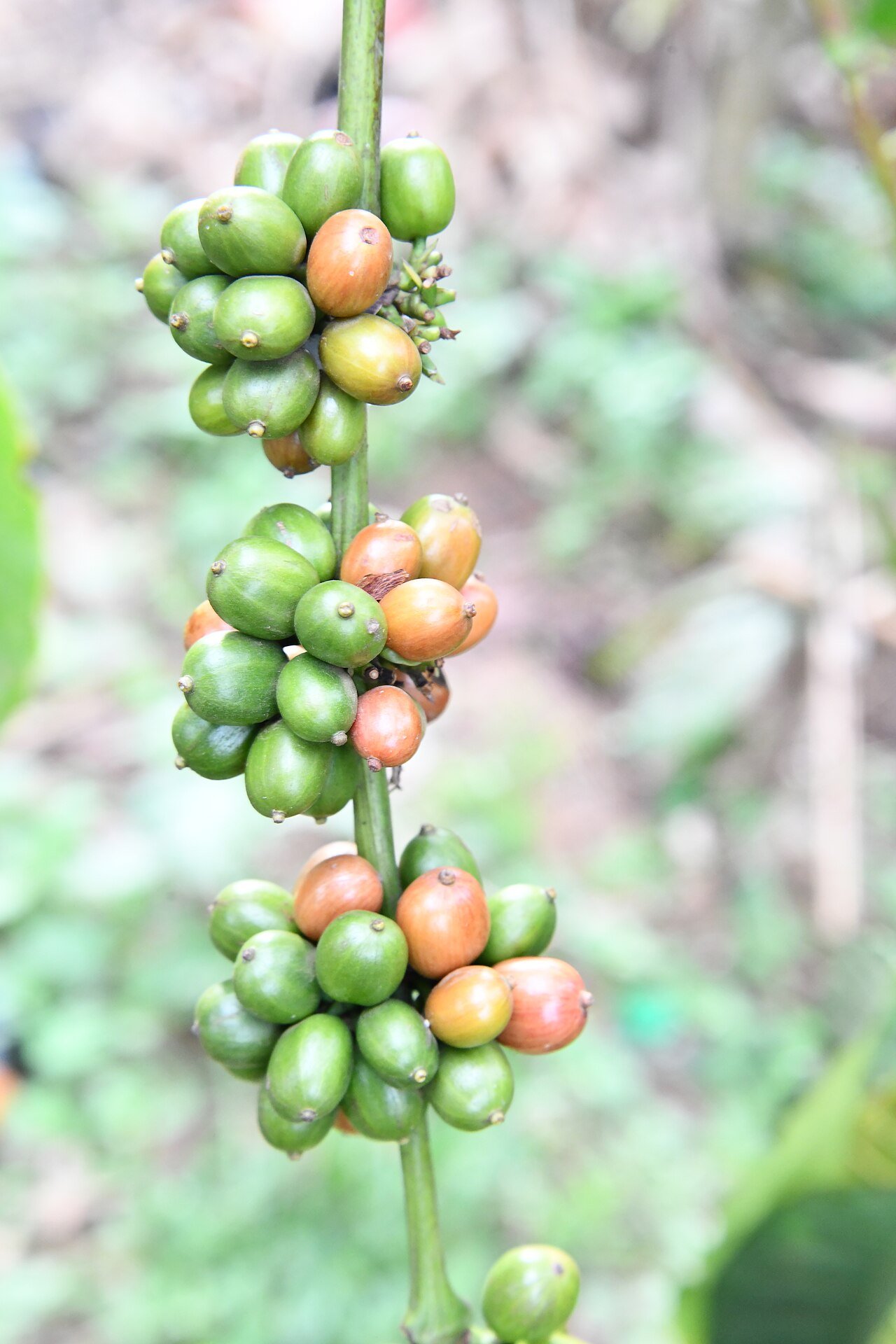
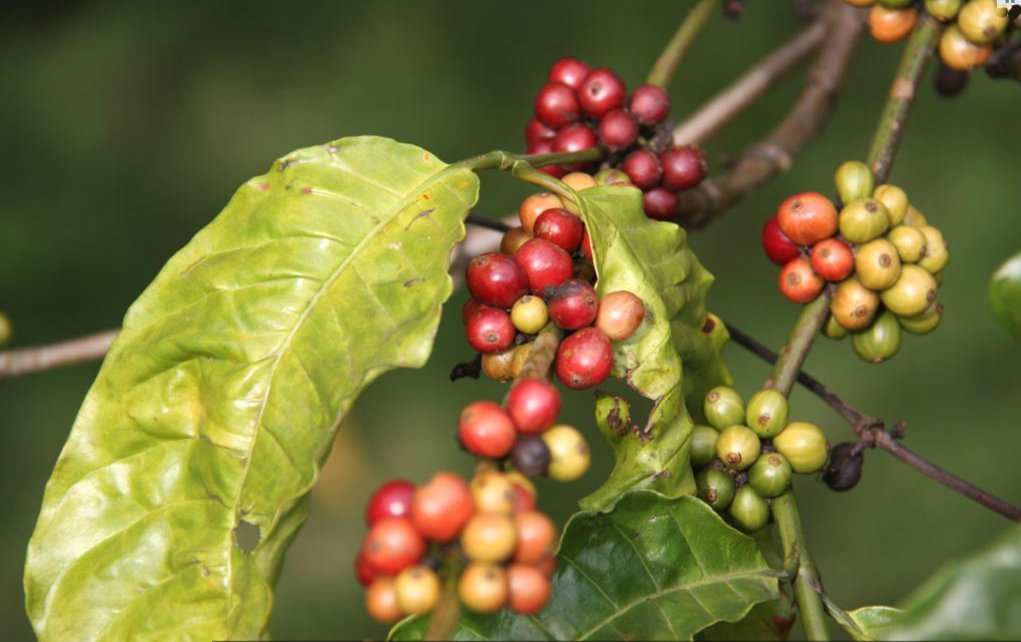
Ripe coffee cherries in Uganda. Photo: Denis Kasozi, CC BY-SA 4.0, via Wikimedia Commons.
Table of Contents
Table of Contents
What are Ugandan coffee beans?
Ugandan coffee beans are coffee grown in Uganda, in East Africa, and sold green (unroasted) for export. Two species grow there:
- Robusta (Coffea canephora), which makes up most of the crop. The USDA Foreign Agricultural Service forecasts 6.025 million bags of Robusta out of a 7.16 million bag crop in 2026/27.
- Arabica (Coffea arabica), about 1.135 million bags in the same forecast, grown mainly on the slopes of Mount Elgon in the east, the Rwenzori Mountains in the west and in the West Nile region.
Uganda has a special claim on Robusta. A review of the country’s coffee trade by a large US importer describes Robusta as considered native to the rainforests of Uganda’s southern Lake Victoria basin. Wild Robusta still grows in Ugandan forests, which is one reason the country has such a deep Robusta culture.
If you are new to the two species, our guides to Arabica vs Robusta and Arabica coffee beans explain the differences in detail.
Why buyers choose Ugandan coffee beans
Roasters and blenders buy Ugandan coffee beans for practical reasons as much as for flavour:
- Clean, pleasant Robusta. Good Ugandan Robusta tends to taste of cocoa, earth and mild spice, with low acidity and less of the harsh, rubbery edge found in poor Robusta.
- Volume and reliability. Uganda grows around 7 million bags a year, and two harvest seasons in different parts of the country mean coffee comes to market for much of the year.
- A real alternative to Asia. Many European roasters use Uganda as a second Robusta origin next to Vietnam or Brazil, so they are not tied to one supply chain.
- Arabica with a name. Bugisu Arabica from Mount Elgon is a recognised origin that sells well as a single origin.
- Value. As we show below, Ugandan Robusta trades well below Arabica prices while still cupping cleanly.
Our comparison of the best Robusta coffee beans puts Uganda next to the other major origins if you want to see the wider picture.
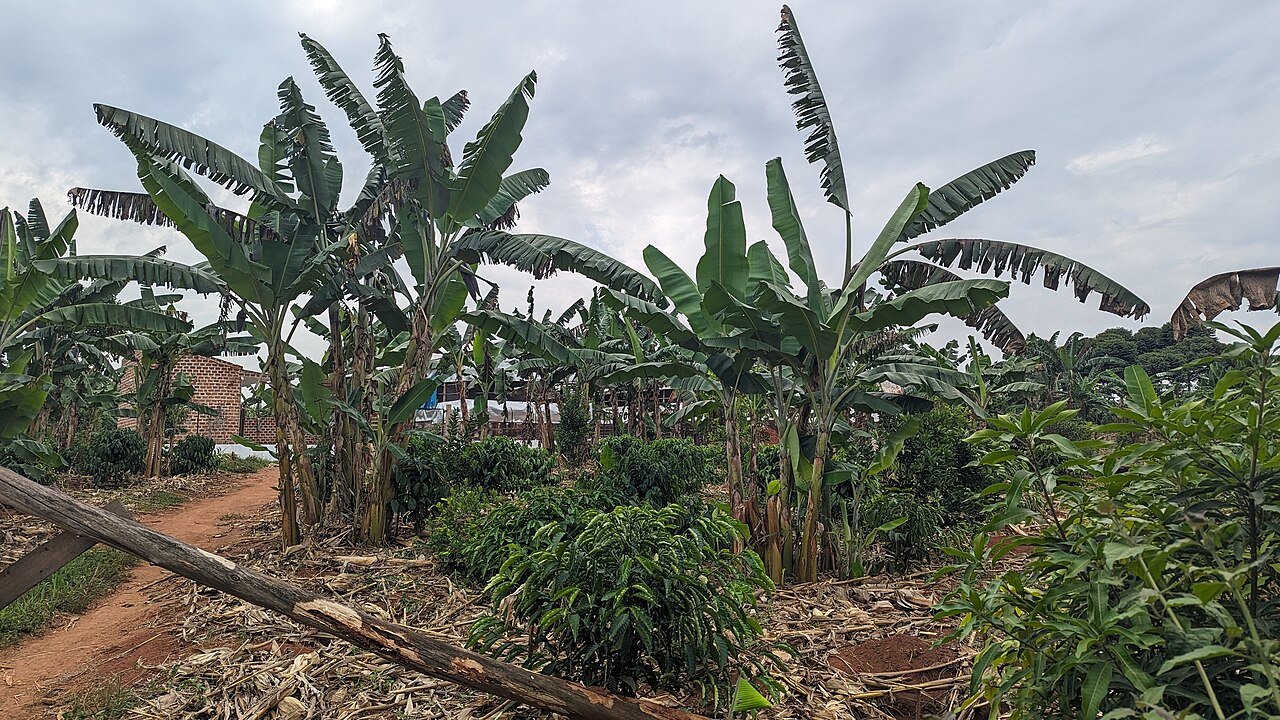
Coffee grown alongside bananas, a common smallholder system in Uganda. Photo: Kateregga1, CC BY-SA 4.0, via Wikimedia Commons.
Ugandan Robusta coffee beans
Robusta is the heart of Uganda’s coffee trade. In February 2026, Robusta made up 79% of the country’s coffee exports, according to the official monthly coffee report.
Most Ugandan Robusta is grown by smallholders around the Lake Victoria basin and in the central and south-western regions, often under or next to bananas and other food crops. It is mostly natural (dry) processed: the cherries are dried whole and then hulled. Some washed Robusta is produced, sold under the name WUR (washed Uganda Robusta), but it is a small share.
How Ugandan Robusta tastes
Typical trade descriptions for good natural Ugandan Robusta are cocoa, dark chocolate, earthy and woody notes, a mild spice, full body and low acidity. It is usually seen as one of the cleaner Robustas, which is why it shows up in Italian-style espresso blends. As with any origin, lots vary, so always cup samples before buying.
Who uses Ugandan Robusta
- Espresso roasters who want body and crema with a smoother cup.
- Instant coffee manufacturers looking for a good-yielding, clean Robusta. See our guide to coffee beans for instant coffee.
- Cold brew and RTD brands that need strength and low acidity. See coffee beans for cold brew.
- Importers and traders who need a second Robusta origin.
Ugandan Arabica coffee beans
Uganda’s Arabica crop is smaller, but it has a good reputation. Average Arabica export prices in February 2026 were US$6.72 per kilo, against US$4.06 for Robusta, which tells you how the market values the two.
There are three main kinds of Ugandan Arabica on export offers:
- Bugisu. Washed Arabica from Mount Elgon in the east, graded by bean size (AA, A, PB, B and so on). It is the best-known Ugandan Arabica, and Bugisu is a registered geographical indication, grown almost entirely on Mount Elgon.
- WUGAR. Washed Uganda Arabica from other regions.
- DRUGAR. Dry-processed (natural) Uganda Arabica. The same importer review says DRUGAR makes up about 50% of Arabica exports.
Washed Bugisu tends to be sweet and balanced, with chocolate, citrus and gentle fruit and a medium body. It is often a little softer and rounder than Kenyan coffee from the other side of the same mountain. Naturals (DRUGAR) are heavier and earthier and are mainly used in blends.
Where Ugandan coffee beans are grown
Uganda’s coffee areas split fairly neatly between Robusta in the lowlands and Arabica in the mountains.
Central region and the Lake Victoria basin (Robusta)
The core Robusta belt around Lake Victoria, including districts around Masaka and the central region. Large volumes, mostly natural-processed, grown by smallholders. This is where most of the Ugandan coffee beans you will see on Robusta offers come from.
South-western Uganda (Robusta)
Another big Robusta area, with farms at somewhat higher altitude than the lake basin. Many buyers find coffee from here a little cleaner and more structured.
Mount Elgon, eastern Uganda (Arabica)
The home of Bugisu Arabica, on the slopes of an extinct volcano on the Kenyan border. Washed coffees, high altitude, volcanic soil. The best-known Ugandan Arabica comes from here.

Sipi Falls on the slopes of Mount Elgon, the area that grows Bugisu Arabica. Photo: Timothy Akolamazima, CC BY-SA 4.0, via Wikimedia Commons.
Rwenzori Mountains, western Uganda (Arabica)
The “Mountains of the Moon” on the border with the Democratic Republic of the Congo. Natural processing is more common here, giving fruity, heavier Arabicas.
West Nile, north-western Uganda (Arabica)
A smaller Arabica area where washed coffee is common. Coffees from here are increasingly showing up as traceable specialty lots.
How Ugandan coffee beans are graded
Ugandan grades are mainly about bean size (screen) and process. The government’s coffee export guidance lists Arabica grades such as Bugisu AA, A, PB, B, C and E, Wugar A, B and C, and Drugar, with Drugar defined as natural dry Uganda Arabica and Wur as washed Uganda Robusta.
For natural Robusta, the main commercial grades are named after screen size. Commercial Robusta is commonly sold as Screen 15 or Screen 12, with the larger screen slightly more valuable. You will also see Screen 18 and Screen 17 on premium offers, and FAQ (“fair average quality”) for ungraded commercial coffee.
| Grade on the offer | What it means | Typical use |
|---|---|---|
| Robusta Screen 18 | Largest natural Robusta beans, most uniform | Premium espresso blends, single-origin Robusta |
| Robusta Screen 15 | Medium beans, the workhorse export grade | Espresso blends, roasters, cold brew |
| Robusta Screen 12 | Smaller beans | Instant coffee, value blends |
| Robusta FAQ | Ungraded commercial coffee | Industrial and soluble use |
| WUR | Washed Uganda Robusta | Cleaner, brighter Robusta for specialty-minded roasters |
| Bugisu AA / A / PB | Washed Arabica from Mount Elgon, by bean size | Single-origin Arabica |
| WUGAR | Washed Uganda Arabica (other regions) | Single origin, blends |
| DRUGAR | Natural (dry) Uganda Arabica | Blends, espresso |
Screen numbers are in 64ths of an inch, so Screen 15 beans stay on a 15/64-inch sieve. Bigger is not always tastier, but bigger, more uniform beans roast more evenly. For the full picture on screens and defect counts, see our guide to coffee bean grading, and for processing, coffee processing methods.
Harvest seasons for Ugandan coffee beans
Uganda sits on the equator, which gives it something useful for buyers: more than one harvest a year, in different parts of the country.
- Northern and eastern areas, including Mount Elgon: main harvest roughly October to February.
- Southern areas: main harvest roughly April to July.
- Fly crop: many regions also produce a smaller off-season crop.
For Robusta in particular, this means fresh Ugandan coffee beans are coming to market for much of the year, which helps buyers who want to keep stock fresh. For Bugisu Arabica, the main window is the October to February harvest, with shipments following a few months later. Our guide to the coffee harvest season shows how Uganda fits into a year-round buying plan across origins.

Freshly harvested coffee in Uganda. Photo: Denis Kasozi, CC BY-SA 4.0, via Wikimedia Commons.
The Ugandan coffee market in 2026
Uganda’s coffee sector has grown quickly over the last few years. Here are the main numbers from official and USDA sources.
- Production: USDA forecasts 7.16 million 60 kg bags in 2026/27, up 0.9%, after 7.095 million in 2025/26 and 6.7 million in 2024/25.
- Exports: the official monthly report puts exports for the twelve months to February 2026 at 8.8 million bags worth US$2.5 billion, up 41% in volume and 61% in value on the year before. USDA’s forecast for the 2026/27 marketing year is 6.83 million bags. The two figures cover different periods and are calculated differently, so do not compare them directly.
- Where it goes: the European Union took about 73% of Uganda’s coffee in 2024/25, per USDA. In February 2026, Italy alone took 28.8% of export volume, followed by Sudan, Germany, India and Morocco.
- Who grows it: smallholders farming 0.5 to 2.5 hectares produce about 90% of output, per USDA.
- Policy: the Uganda Coffee Development Authority was merged into the Ministry of Agriculture, Animal Industry and Fisheries, and the government is signalling a gradual move towards more roasted and soluble coffee exports.
What this means for buyers: supply is large and steady, Europe is the main competitor for the best lots, and Italian roasters in particular value Ugandan Robusta highly. If Uganda does shift more coffee into local processing over time, green supply for export could tighten at the margin, so a reliable supplier relationship is worth having.
What Ugandan coffee beans cost
Like all green coffee, the price of Ugandan coffee beans is built from the futures market plus a differential:
- Robusta follows the London Robusta futures market.
- Arabica follows the New York “C” market.
- The differential reflects origin, grade, screen, process and how scarce good lots are at the time.
- Freight and terms add the cost of getting coffee from Uganda to your port.
For a sense of scale, the official February 2026 report gives average export prices of US$4.06 per kilo for Robusta and US$6.72 for Arabica, down slightly from January. USDA puts Uganda’s average export price at US$4.51 per kilo in 2025/26, against US$4.64 in 2024/25 and US$2.63 in 2023/24. Those are averages across all grades, not a quote. Screen 18 Robusta and top Bugisu lots cost more, Screen 12 and FAQ less.
The jump between 2023/24 and 2024/25 shows how much world coffee prices moved. If you want to understand what drives those swings and how futures turn into your invoice price, read our guide to green coffee prices.
Shipping Ugandan coffee beans from a landlocked country
Uganda has no coastline. Much of its coffee ships through the Kenyan port of Mombasa, with some going through Dar es Salaam in Tanzania. That has a few practical effects:
- Transit takes longer than from a coastal origin, because coffee moves by road or rail to the port first.
- Inland freight adds cost, which is built into FOB Mombasa prices.
- Containers are usually stuffed inland in Kampala and trucked to the port, so moisture control at loading matters.
None of this is a reason to avoid Ugandan coffee beans, but plan your timing with it in mind. If you are new to importing, our step-by-step guide to importing coffee beans covers Incoterms, documents and customs.
EUDR and traceability for Ugandan coffee
Because about three-quarters of Uganda’s coffee goes to the European Union, the EU Deforestation Regulation matters a lot for this origin. After two delays, larger operators and traders must comply from 30 December 2026, and very small businesses from 30 June 2027. Buyers will need geolocation data showing the coffee was not grown on recently deforested land.
With so many small farms, traceability back to the plot is a big job in Uganda. If you sell into Europe, ask every supplier what traceability data comes with a lot of Ugandan coffee beans before you sign. Our guide to choosing a green coffee supplier lists the questions to ask.
Best uses for Ugandan coffee beans
Espresso blends
This is the classic use, especially in Italian-style blends. A 20% to 40% share of Ugandan Robusta adds body, crema and a chocolate-cocoa base under Arabica. Our guide to coffee beans for espresso has blend ratios to start from.
Single-origin Robusta
Clean Screen 18 or washed Ugandan Robusta can stand on its own as a “fine Robusta” single origin, especially for strong filter, moka pot or milk drinks.
Instant and soluble coffee
Ugandan Robusta is a well-used raw material for instant coffee, with good body and yield.
Cold brew and ready-to-drink
Low acidity and strong cocoa notes suit long cold steeps and milk-based drinks.
Single-origin Arabica
Bugisu and traceable West Nile or Rwenzori lots work as approachable East African single origins, a little softer and cheaper than many Kenyan or Ethiopian coffees. Our guides to single origin coffee beans and Ethiopian green coffee beans can help you build an African range around it.
Roasting Ugandan coffee beans
General guidance that roasters commonly share, not a fixed profile:
- Robusta likes a fuller roast. Most Ugandan Robusta is roasted medium to medium-dark for espresso. Under-developed Robusta tastes grainy and harsh.
- Give it time. Robusta often benefits from a slightly longer development phase than Arabica to round off bitterness.
- Pre-blend or post-blend? Many roasters roast Robusta separately from Arabica and blend afterwards, because the two behave differently in the drum.
- Bugisu Arabica is dense high-grown coffee and usually shines at light to medium roasts for filter, medium for espresso.
- Screen matters. Mixing Screen 12 and Screen 18 in one batch gives an uneven roast. Buy a consistent screen.
Our full guide to roasting green coffee beans goes step by step, and coffee cupping explains how to judge your results.
Which Ugandan grade fits your business?
Buying the most expensive grade is not always the smart move. The right Ugandan coffee beans depend on what you make and how you sell it.
Specialty roaster or café
Look at washed Bugisu AA or A, or a traceable West Nile or Rwenzori lot, for a single-origin Arabica. If you want a Robusta on the menu that people will actually enjoy black, go for Screen 18 natural or washed Robusta (WUR) and roast it with care. A “fine Robusta” from Uganda is still unusual on most café menus, which can be a selling point.
Wholesale roaster supplying restaurants and offices
Screen 15 natural Robusta is the workhorse. Blended with a Brazilian or East African Arabica, it gives a strong, chocolatey espresso that works well with milk and keeps your cost per cup under control.
Instant coffee and soluble plants
Screen 12 and FAQ grades are often fine for extraction, where yield and cleanliness matter more than bean size. Ask for moisture and defect figures, because faults come through in the extract.
Private-label, cold brew and RTD brands
Consistency is everything. Pick one grade and process, approve a spec, and buy the same profile each time. Screen 15 natural Robusta is easy to repeat crop after crop.
Importers and traders
A spread of grades (Screen 18, 15, 12 and DRUGAR) lets you serve roasters, blenders and industrial buyers from one origin. Uganda’s two harvest seasons help keep your offer list fresh.
Washed Robusta (WUR): worth a look
Most Ugandan Robusta is natural, but washed Robusta is worth knowing about. Removing the fruit before drying usually gives a cleaner, brighter cup with less of the earthy, woody character. It costs more and the volumes are smaller.
Our opinion, for what it is worth: if you have tried Robusta and found it too rough, a washed Ugandan lot is a good place to start again. It can work as a single origin, and in a blend it lets you use a higher share of Robusta without the cup turning harsh. We can supply Ugandan Robusta washed on request, so ask when you request samples.
Ugandan Arabica vs Kenyan and Ethiopian
Buyers often ask how Ugandan Arabica coffee beans compare with their more famous neighbours. A rough guide, based on typical trade descriptions rather than any single lot:
| Origin | Typical washed cup | Price position | Good for |
|---|---|---|---|
| Uganda (Bugisu) | Sweet, balanced, chocolate and citrus, medium body | Usually below Kenya and top Ethiopian lots | Approachable single origin, blends |
| Kenya | Juicy, blackcurrant, bright acidity | Usually higher | Bold single origin |
| Ethiopia | Floral, citrus, tea-like; naturals very fruity | Wide range, top lots high | Signature single origin |
So Ugandan Arabica is often the value choice in East Africa: recognisably East African, easy to drink, and kinder on the budget. All three are available through our Africa Arabica single-origin range, so you can cup them side by side.
How much to buy: bags or containers?
Ugandan coffee beans ship in 60 kg jute bags. A 20-foot container is commonly loaded with around 320 bags, about 19.2 tonnes. As a rough guide:
- Small roasters often start with a few bags, through an importer or as part of a mixed order.
- Growing roasters using a few hundred kilos of Robusta a month may find a part-container order, or splitting a container with another buyer, makes sense.
- Large roasters, instant plants and traders usually buy by the full container, which brings the price per kilo down and simplifies logistics.
Think about storage too. Buying a year’s supply of Robusta at once may lock in a price, but only if you can store it well. Uganda’s two harvests make it easier to buy more often in smaller amounts and keep stock fresh.
A simple tasting plan for Ugandan samples
- Request three samples that differ on one thing, for example Screen 15 and Screen 18 natural, plus a washed lot.
- Check the green. Measure moisture, count defects on a 300 g sample, look at bean size consistency and smell for mustiness.
- Roast each sample the same way, medium to medium-dark for Robusta, so you compare the coffee rather than the roast.
- Cup them blind if you can.
- Brew the way you will sell it. Pull espresso shots in your blend ratio, or cold-brew it if that is the plan.
- Approve a pre-shipment sample from the actual lot before it ships.
Questions to ask any supplier of Ugandan coffee
- Is it Robusta or Arabica, natural or washed?
- What screen or grade, and what were the defect count and moisture on this lot?
- Which region, and which crop and season?
- Through which port will it ship, and what is the expected arrival date?
- What traceability data comes with it, especially for EU buyers?
- Can I have a pre-shipment sample from the actual lot?
- What are the delivery terms and payment terms?
A good supplier answers all of these without fuss. We do, for every lot of Ugandan coffee beans we offer.
What Ugandan Robusta does to your blend cost
Here is a simple worked example, using the official February 2026 average export prices of US$6.72 per kilo for Ugandan Arabica and US$4.06 for Ugandan Robusta. These are export averages, not landed prices, so treat the result as a comparison rather than a budget.
| Blend | Green cost per kilo (our calculation) | Difference |
|---|---|---|
| 100% Arabica | US$6.72 | baseline |
| 80% Arabica / 20% Ugandan Robusta | about US$6.19 | about 8% cheaper |
| 70% Arabica / 30% Ugandan Robusta | about US$5.92 | about 12% cheaper |
| 50% Arabica / 50% Ugandan Robusta | about US$5.39 | about 20% cheaper |
To put it per cup: roasting removes roughly a sixth of the weight of green coffee, so an 18 g espresso dose needs a little under 22 g of green. At these prices that is about 14.6 US cents of green coffee per shot for 100% Arabica and about 12.8 cents for a 70/30 blend. Small per cup, but across tens of thousands of cups a year it adds up, and many customers prefer the extra body and crema anyway.
The real numbers for your business depend on the Arabica you blend with, freight, duties and roast loss, so run the same sums with your own quotes. We are happy to quote both sides of the blend so you can compare.
A year-round buying plan for Ugandan coffee
Because Uganda harvests in different seasons in the north and south, you can plan purchases of Ugandan coffee beans in two main windows rather than one:
- Around the turn of the year: book new-crop Bugisu Arabica and northern coffee from the October to February harvest.
- Mid-year: book southern Robusta from the April to July harvest.
- In between: fill gaps from stock and fly-crop coffee, and use the time to sample new lots for the next contract.
Splitting orders this way keeps your stock fresher and spreads your exposure to price moves across the year.
Our Ugandan coffee beans
We sell Ugandan coffee beans in two ways: as natural Robusta graded by screen, and as Ugandan Arabica within our single-origin African Arabica range.
Ugandan Robusta coffee beans

Green, sorted by screen size and packed for export. A clean, cocoa-led Robusta for espresso blends, instant coffee, cold brew and supply diversification. Washed Robusta is available on request.
Ugandan Robusta coffee beans, short spec:
- Species: Coffea canephora (green beans)
- Origin: Uganda
- Altitude: 900 to 1,500 m
- Process: natural, washed on request
- Screen: 15 to 18
- Moisture: max 12%
- Cup: cocoa, earthy, mild spice, low acid
- Packing: 60 kg jute bags
Ugandan Arabica, single origin

Uganda is one of the countries in our traceable Africa Arabica range. Tell us the region, process and grade you want and we will send offers and samples of the Ugandan Arabica coffee beans we can supply.
Africa Arabica coffee beans, short spec:
- Species: Coffea arabica (green beans)
- Origins: Ethiopia, Kenya, Uganda, Tanzania, Rwanda, Burundi
- Sold as: single-origin, traceable lots
- Altitude: 1,300 to 2,200 m
- Process: washed, natural or honey
- Screen: 15 to 18, plus PB
- Moisture: max 12.5%
- Cup: floral, fruity, bright, clean
- Packing: 60 kg jute bags
Related African coffees
For a broader East African Arabica blend component, see our African Arabica coffee beans (washed or natural, screen 15 to 18, AA/AB, moisture max 12.5%). For Robusta from several African countries matched to your spec, including higher-caffeine lots at 2.2% to 2.7%, see our African Robusta coffee beans.

Ugandan coffee beans vs other Robusta origins
Most of our customers buy Ugandan Robusta alongside one or two other Robusta origins. Here is how they compare, based on our product specs and typical trade descriptions.
| Origin | Typical cup | Screen | Strengths |
|---|---|---|---|
| Uganda | Cocoa, earthy, mild spice, low acid | 15 to 18 | Clean African Robusta, two harvests a year |
| Vietnam | Sweet, rich aroma, mild acidity | 16/18 | Huge volume, great value |
| Brazil (Conilon) | Smooth, chocolate, nutty, low acid | 16/18 or 18/20 | Soft, easy blending base |
| India | Smooth, chocolate, nutty, low acid | 17/18 or 18/20 | Very clean, shade-grown |
| Indonesia | Heavy, chocolate, cedar, low acid | 16/18 or 18/20 | Big body for milk drinks |


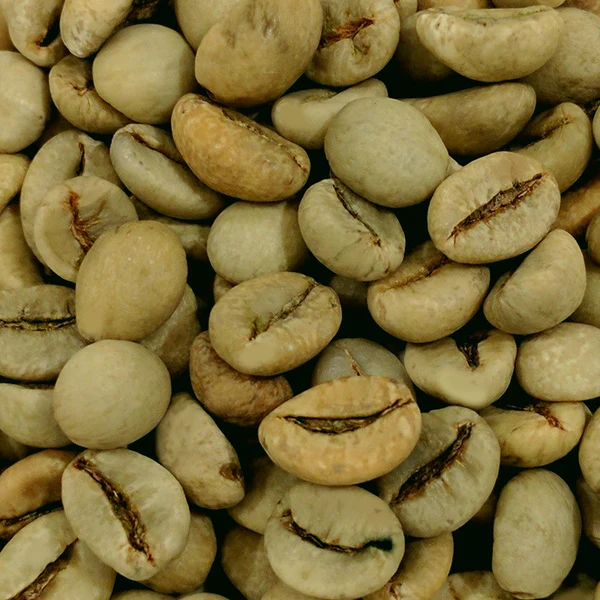

A common pairing is Ugandan Robusta with Brazilian Conilon: Uganda brings cocoa and structure, Brazil brings softness and sweetness. Another is Uganda with Indian Robusta for a very clean, premium Robusta component. See everything in our Robusta coffee beans and Arabica coffee beans categories, or on the full products page.
Three starting blends using Ugandan coffee beans
First trials for your own cupping table, not finished recipes:
- Italian-style espresso: 60% Brazilian Arabica or Conilon base, 30% Ugandan Robusta, 10% Indian Robusta. Body, crema, chocolate.
- All-African espresso: 60% East African Arabica, 40% Ugandan Robusta. Fruit on top, cocoa underneath.
- Strong cold brew: 50% Ugandan Robusta, 50% Brazilian Conilon. Low acid, chocolatey, holds up to milk.
Storing Ugandan coffee beans
Robusta is fairly forgiving in storage, but it still fades and picks up musty notes if kept warm and damp. Keep bags on pallets, off walls, in a cool, dry, ventilated space, and check moisture on arrival against the contract. For specialty Bugisu lots, hermetic liners help. Robusta for blends is usually fine in plain jute if you turn stock over within several months. If you are holding coffee longer than that to hedge prices, check moisture and smell every few weeks and use the oldest bags first. Our guide to storing green coffee beans goes into detail.
A quick glossary of Ugandan coffee terms
Ugandan offers and contracts use a handful of local and trade terms that can confuse first-time buyers. Here are the ones you will meet most often.
- Bugisu: washed Arabica from Mount Elgon, graded AA, A, PB, B and so on by bean size.
- WUGAR: washed Uganda Arabica from regions other than Bugisu.
- DRUGAR: dry-processed (natural) Uganda Arabica.
- WUR: washed Uganda Robusta.
- Screen 18 / 15 / 12: natural Robusta grades by bean size, in 64ths of an inch.
- FAQ: fair average quality. Inside Uganda the term is used for hulled natural coffee before it is sorted into export grades; on export offers it usually means ungraded commercial coffee.
- Kiboko: the local name for dried coffee cherries before hulling.
- Parchment: washed coffee that still has its thin papery husk, stored this way before final milling.
- Fly crop: a smaller, off-season harvest.
- FOB Mombasa: price for coffee loaded on a ship at the Kenyan port, before sea freight.
Knowing these terms makes it much easier to compare offers for Ugandan coffee beans from different suppliers side by side.
Common mistakes when buying Ugandan coffee beans
- Buying FAQ when you need Screen 15 or 18. Ungraded coffee is cheaper for a reason. For roasting, buy a defined screen.
- Mixing screens. Inconsistent bean size roasts unevenly.
- Ignoring moisture. Wet coffee costs you money and risks mould on the long route to the coast.
- Not planning for transit time. Inland transport to Mombasa adds days to weeks.
- Skipping samples. Two Screen 15 lots can cup very differently.
- Forgetting EUDR. If you sell in the EU, ask about traceability data before you buy.
How to order Ugandan coffee beans from us
We supply Ugandan coffee beans to roasters, blenders, instant coffee makers, cold brew brands and traders around the world.
- Tell us what you need. Robusta or Arabica, screen or grade, process, volume and destination port.
- Get offers and samples of the lots that fit.
- Agree the contract: grade, crop, moisture, packing, price and delivery terms in writing.
- Approve a pre-shipment sample from the actual lot.
- We load and ship, and the documents follow.
If you buy in volume, our guide to wholesale green coffee beans explains container buying. When you are ready, contact our sales team for current offers, or read more about Continental Coffee Supply.
Frequently asked questions
Are Ugandan coffee beans Arabica or Robusta?
Both, but mostly Robusta. USDA forecasts about 6 million bags of Robusta and 1.1 million bags of Arabica in 2026/27.
What do Ugandan coffee beans taste like?
Ugandan Robusta is typically cocoa, earthy and mildly spicy with low acidity and full body. Washed Bugisu Arabica is sweet and balanced, with chocolate and citrus.
What is Bugisu coffee?
Washed Arabica grown on Mount Elgon in eastern Uganda, graded by bean size (AA, A, PB and so on). Bugisu is a registered geographical indication.
What does Screen 15 mean?
The beans stay on a sieve with holes 15/64 of an inch across. Screen 15 is the main export grade for natural Ugandan Robusta; Screen 18 is larger and Screen 12 smaller.
When are Ugandan coffee beans harvested?
Northern and eastern areas mainly harvest October to February, southern areas April to July, with a smaller fly crop in many regions.
How much do Ugandan coffee beans cost?
Prices follow the futures markets plus a differential. Official February 2026 averages were about US$4.06 per kilo for Robusta and US$6.72 for Arabica at export. We quote each order.
Are Ugandan coffee beans good for espresso?
Yes. Ugandan Robusta is widely used in espresso blends for body, crema and cocoa notes.
Are Ugandan coffee beans good for instant coffee?
Yes. Clean natural Ugandan Robusta is a popular raw material for soluble coffee.
Which port does Ugandan coffee ship from?
Uganda is landlocked, so much of its coffee ships through Mombasa in Kenya, with some through Dar es Salaam.
Do you ship Ugandan coffee beans worldwide?
Yes, by the bag, ton or container, to ports around the world.
Can I get samples first?
Yes. We recommend cupping and roasting samples before ordering in volume.
Key takeaways
- Ugandan coffee beans are mostly natural Robusta, with a smaller Arabica crop led by Bugisu from Mount Elgon.
- Ugandan Robusta is clean, cocoa-led and low in acidity, ideal for espresso, instant and cold brew.
- Robusta is graded mainly by screen (18, 15, 12, FAQ); Arabica as Bugisu, WUGAR or DRUGAR.
- Two harvest seasons keep fresh Ugandan coffee coming to market for much of the year.
- Exports reached 8.8 million bags worth US$2.5 billion in the twelve months to February 2026.
- About three-quarters goes to the EU, so EUDR traceability matters from 30 December 2026.


Leave a Comment
Your email address will not be published. Required fields are marked *