Green coffee prices are set every day by world markets, and they move a lot. As a reference point, the International Coffee Organization’s composite price for green coffee averaged 262.18 US cents per pound in September 2026, or roughly US$5.78 per kilo, down 8.7% from August as Brazil’s record harvest reached the market. Robusta averaged 167.49 cents per pound (about US$3.69 per kilo), while washed Arabicas averaged between about 329 and 356 cents per pound.
What you actually pay for a lot of green coffee is that market level plus or minus a differential for origin and quality, plus packing, freight and import costs. That is why green coffee suppliers, including us, quote each order rather than printing a fixed price list.
This guide explains green coffee prices from a buyer’s point of view: where prices stand now, how they are set, what drives them up and down, how an exchange price becomes the price on your invoice, and how to get the best value without gambling on the market. Figures come from the International Coffee Organization, ICE (the exchange where coffee futures trade) and the USDA, all linked. Conversions from cents per pound to dollars per kilo are our own calculations. Market prices change daily, so treat the numbers here as a snapshot, not a quote.
Green coffee prices right now
The table below shows the ICO’s indicator prices for September 2026, from its Coffee Market Report for September 2026. The ICO splits coffee into four groups, which helps because different types of coffee sell at very different levels.
| ICO group (September 2026 average) | US cents per lb | Approx. US$ per kg (our conversion) | Change vs August |
|---|---|---|---|
| ICO Composite Indicator (I-CIP) | 262.18 | about $5.78 | down 8.7% |
| Colombian Milds (washed Arabica) | 356.15 | about $7.85 | down 8.1% |
| Other Milds (other washed Arabica) | 329.44 | about $7.26 | down 8.8% |
| Brazilian Naturals (natural Arabica) | 290.19 | about $6.40 | down 9.9% |
| Robustas | 167.49 | about $3.69 | down 7.3% |
A few things to know about these numbers. They are reference prices for large volumes of exportable coffee, not landed prices in your warehouse. They do not include freight, insurance, import costs or the premium for top grades. And they change every day: according to the same ICO report, the composite price ranged from 248.44 to 279.85 US cents per pound during September 2026 alone.
Still, they are the best public starting point for understanding green coffee prices, and they show the big picture clearly: Robusta trades at less than half the price of most Arabica.
How green coffee prices are set
Most of the world’s green coffee is priced off two futures markets run by ICE.
Arabica: the Coffee “C” contract
ICE describes its Coffee “C” futures contract as the world benchmark for Arabica coffee. Each contract is for 37,500 pounds of exchange-grade green beans, priced in US cents per pound, and settled by physical delivery from one of about 20 approved origins to licensed warehouses in the US and Europe. Coffees are graded and cup-tested; better coffees trade at a premium and lower ones at a discount. ICE lists origin premiums and discounts too: for example, Colombia, Costa Rica and Kenya at a 1,000-point premium, and Brazil at a 600-point discount, with Vietnam due to become deliverable at a 600-point discount from the May 2027 expiry.
Robusta: the London contract
Robusta trades on ICE Futures Europe in London. In a 2025 regulatory filing about a new metric Arabica contract, ICE notes that its London Robusta futures contract has a contract size of 10 metric tons (ICE filing). Robusta futures are quoted in US dollars per tonne rather than cents per pound.
The ICO Composite Indicator
Alongside the exchanges, the ICO publishes the Composite Indicator Price (I-CIP). The ICO says it was established in the 1960s, is one of the key reference prices in the coffee industry, is split into four coffee groups, and is published daily. It is a useful way to follow overall green coffee prices without watching two exchanges at once.
Arabica vs Robusta: why green coffee prices differ so much
The gap between the two species is one of the most important things to understand about green coffee prices. In September 2026, the ICO reports that the arbitrage between the London (Robusta) and New York (Arabica) futures markets was 126.40 US cents per pound, after narrowing 13.2% in the month (ICO). New York Arabica futures averaged 280.68 cents per pound and London Robusta futures averaged 154.28 cents per pound.
Robusta is cheaper because the plant yields more, grows at lower altitudes where farming is easier, and resists disease better, so it costs less to produce. It is also used heavily in instant coffee and blends, where buyers are price-sensitive. Our guide to Arabica vs Robusta explains the differences in detail.
For buyers, this gap is useful. Adding a share of good Robusta to a blend lowers the average cost per kilo, and done well it can improve body and crema. Our guide to coffee beans for espresso shows blend ratios.
What moves green coffee prices
Green coffee prices react to supply, demand, weather, stocks and money flows. The ICO’s September 2026 report sets out the forces at work that month, summarised below from its market report.
| Factor (ICO, September 2026) | Effect on prices | What happened |
|---|---|---|
| Brazilian supply | Downward | Brazil’s harvest was reported 97% complete by late August, and Brazil’s CONAB raised its 2026/27 crop estimate to a record 67.6 million bags |
| Demand | Downward | The ICO estimates 2025/26 consumption will fall 0.8% |
| Global balance | Downward | A 3.0 million-bag surplus in coffee year 2025/26 after four deficit years, which the ICO notes is less than one week of world consumption |
| Weather and climate | Both ways | A greater than 90% chance of a very strong El Niño, per NOAA, adding risk; drought alerts in Honduras and Nicaragua |
| Exchange stocks | Both ways | ICE Arabica certified stocks fell to 217,646 bags on 15 September, the lowest since 1999, before rising |
The biggest single driver is usually Brazil. The USDA says Brazil accounts for nearly 40% of world production and that weather in Minas Gerais is the main indicator for world market conditions, because Brazil’s Arabica crop swings by millions of bags between “on” and “off” years (USDA, July 2026). The USDA forecasts a record world crop of 189.7 million bags for 2026/27 and noted that coffee prices had already dropped 25% in the seven months before its July report as more supply became available.
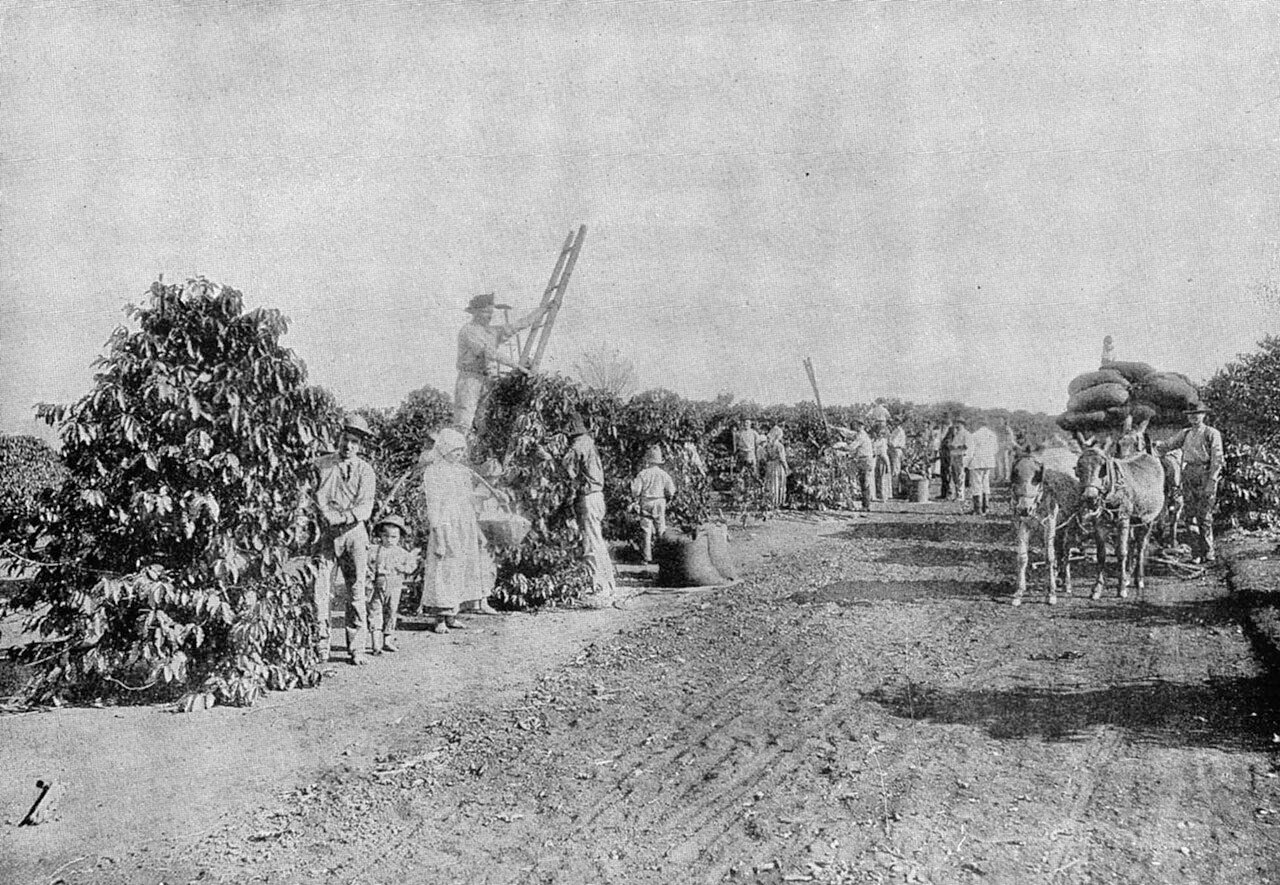
For buyers, this means green coffee prices tend to fall when big harvests arrive and rise when weather threatens the next one. Our guide to the coffee harvest season explains when each origin’s crop comes in.
Green coffee prices by type and grade
Within each species, green coffee prices spread out by type and grade. As a general picture, drawn from how the market is structured rather than from a single price list:
- Commercial Robusta sits at the bottom of the range and is used mostly for instant coffee and value blends.
- Clean, well-sorted Robusta, such as large-screen or washed lots, sells above standard grades and suits espresso blends.
- Natural Arabica, typified by the ICO’s Brazilian Naturals group, usually sits below washed Arabica.
- Washed Arabica, the ICO’s Colombian Milds and Other Milds groups, carries higher green coffee prices.
- Specialty and single-origin lots trade at premiums well above the indicators, sometimes by a wide margin, because of cup quality and traceability.
Knowing where a coffee sits in this range helps you judge whether a quote is reasonable. A specialty Arabica quoted at a commercial Robusta price, for example, should make you ask questions.
Seasonal patterns in green coffee prices
Green coffee prices do not follow a fixed calendar, but some patterns are worth knowing. When a big harvest, especially Brazil’s, starts reaching the market, the extra supply tends to weigh on prices, as the ICO described for September 2026. When weather threatens the next crop, for example during Brazil’s flowering or a dry spell, prices can jump. Treat these as tendencies, not rules: speculation, currency moves and stock levels can override them. Our coffee harvest season guide explains when each origin harvests, which helps you understand why green coffee prices move at certain times of year.
Currency and green coffee prices
Green coffee is traded mostly in US dollars. If your business earns in another currency, the cost of coffee to you changes with the exchange rate as well as with the market. A stronger local currency makes coffee cheaper for you; a weaker one makes it more expensive, even if green coffee prices in dollars stay the same. Exchange rates in producing countries also matter, because they affect how much farmers earn and how quickly they sell. Many buyers watch the dollar alongside the coffee market, and larger buyers sometimes fix exchange rates ahead with their bank.
From exchange price to the price you pay
The futures price is only the starting point. A typical price for a physical lot of green coffee is built up like this:
- Market price. The futures price on the day the price is fixed: ICE “C” for Arabica, London for Robusta.
- Differential. A premium or discount for the particular origin, grade, processing and quality. Specialty lots can carry large premiums; lower grades trade at discounts.
- Origin costs. Milling, sorting, bagging, transport to port and export paperwork, usually already built into an FOB (free on board) price.
- Freight and insurance. Sea freight to your port and cargo insurance. These are included in a CFR or CIF price.
- Import costs. Port charges, customs clearance, any duty or tax, and inland transport.
- Financing and storage. The cost of paying for coffee before you roast or sell it, and warehouse costs.
So when you compare green coffee prices from different suppliers, make sure you compare on the same basis. A low FOB price can turn into an expensive coffee once freight and import costs are added. Our guide to importing coffee beans explains FOB, CFR and CIF terms, and our guide to wholesale green coffee beans covers contracts and order sizes.

Differentials in green coffee prices: why two Arabicas cost different amounts
Even within Arabica, green coffee prices vary widely by type. The ICO tracks the gaps between its groups. In September 2026, it reports the Colombian Milds–Brazilian Naturals differential at 65.95 US cents per pound and the Colombian Milds–Robustas differential at 188.66 cents per pound (ICO). In other words, washed Colombian-style Arabica was selling for roughly two-thirds of a dollar more per pound than natural Brazilian Arabica, and nearly two dollars more than Robusta.
On the exchange itself, ICE sets fixed premiums and discounts by origin for coffee delivered against the “C” contract, such as a 1,000-point premium for Colombia, Costa Rica and Kenya and a 600-point discount for Brazil (ICE). In the physical market, differentials also reflect grade, processing, cup quality, certifications and how much buyers want that particular coffee at that moment. Our guide to coffee bean grading explains why higher grades command higher prices.
Green coffee prices are volatile
Coffee is one of the more volatile commodities. The ICO measured the volatility of its composite price at 10.0% in September 2026, down from 13.7% in August, with New York Arabica futures at 13.4% and London Robusta futures at 9.7% (ICO). In plain terms, prices can move several percent in a day and much more over a few weeks.
That volatility is the main reason green coffee suppliers quote each order fresh. A price from last month may be well out of date. It is also why buyers think carefully about when and how they fix the price of their coffee, which we cover below.

Units used for green coffee prices: cents per pound, dollars per kilo, dollars per tonne
Green coffee prices are quoted in different units depending on the market, which confuses many first-time buyers. Arabica futures are in US cents per pound, Robusta futures in US dollars per tonne, and many suppliers quote per kilo or per 60 kg bag. These conversions are simple arithmetic (one pound is about 0.4536 kg), and the figures below are our own rounded calculations:
| Quoted as | Equals roughly |
|---|---|
| 100 US cents per lb | US$2.20 per kg, or US$2,205 per tonne |
| US$1,000 per tonne | US$1.00 per kg, or 45.4 US cents per lb |
| One 60 kg bag at US$5.00 per kg | US$300 per bag |
Using that conversion, the September 2026 averages work out to roughly US$6.19 per kilo for New York Arabica futures and US$3.40 per kilo (about US$3,400 per tonne) for London Robusta futures, before any differential or costs.
What you get at different price levels
It helps to think about green coffee prices in terms of what each level buys you. At the lower end, standard Robusta gives strength and body at a low cost, and suits instant coffee, value blends and dark roasts. A step up, clean, large-screen or washed Robusta gives a smoother cup and lets you use more Robusta in espresso. Natural Arabica brings sweetness, body and a softer acidity at a moderate price.
Washed Arabica costs more again and gives clarity and brightness. At the top, specialty single origins carry premiums for flavour, consistency and traceability. None of these is “right”. The best value is the cheapest coffee that still does the job your customers expect.
Green coffee prices for instant and soluble coffee
Instant coffee makers think about green coffee prices differently from cafés. They need large, steady volumes, a consistent flavour after extraction and a cost that works at scale, so Robusta dominates. Small changes per kilo matter a great deal when buying by the container, which is why soluble producers watch the London Robusta market and differentials closely, and often use forward contracts and staged deliveries. Our Robusta range, including Vietnam Robusta and Brazilian Robusta, is commonly used for this kind of production.
How to track green coffee prices yourself
You don’t need a trading screen to keep an eye on the market. The ICO publishes its Composite Indicator Price and four group prices daily, which it describes as one of the key reference prices of the coffee industry (ICO). It also publishes a free monthly Coffee Market Report, and in September 2026 it launched the Coffee Market Intelligence Platform, a free-to-view tool combining daily market indicators with trade and production data (ICO, September 2026). The USDA publishes its Coffee: World Markets and Trade report twice a year, with the next edition due on December 16, 2026 (USDA).
Checking these once a month gives you a good feel for where green coffee prices are heading and why, which makes conversations with suppliers much easier.
Managing the risk of changing green coffee prices
Because green coffee prices move so much, buyers use a few common approaches to avoid nasty surprises. These are widely used trade practices, described in general terms; they are not financial advice.
- Fixed-price contracts. You agree a flat price per kilo or per pound when you sign. Simple, and you know your cost, but you won’t benefit if the market falls.
- Price-to-be-fixed (differential) contracts. You agree the differential now and fix the futures part later, on a day you choose before an agreed deadline. This gives flexibility but means you carry the market risk until you fix.
- Staggered buying. Instead of buying a whole year at once, you buy or fix in several stages. You get an average of the market rather than betting on one day.
- Forward contracts with staged shipments. You agree your yearly volume and price structure, then take delivery in several shipments, which also keeps stock fresh.
- Hedging. Large buyers sometimes use futures or options to offset price risk. It needs expertise and is usually done with a broker.
For most small and mid-size roasters, a mix of fixed-price contracts and staggered buying works well. If you are unsure, ask your supplier to explain the options on each quote.

Is now a good time to buy?
Nobody can reliably predict green coffee prices, and we are not financial advisers, so here is a balanced summary of the signals in the latest official data rather than a forecast.
On the side of lower prices: Brazil’s record crop is reaching the market, the ICO estimates a 3.0 million-bag global surplus for coffee year 2025/26 after four years of deficit, and the USDA forecasts record world production of 189.7 million bags in 2026/27 (ICO; USDA). The composite price fell 8.7% in September 2026 alone.
On the side of higher prices: the ICO points out that the surplus is less than one week of world consumption, cites a greater than 90% chance of a very strong El Niño according to NOAA, notes drought alerts in Honduras and Nicaragua, and reports that ICE Arabica certified stocks hit their lowest level since 1999 in mid-September before recovering (ICO).
The practical takeaway: when signals are mixed, many buyers prefer to cover part of their needs now and leave part open, rather than trying to time the bottom. Whatever you decide, fresh quotes and good information from your supplier help more than headlines.
How to get the best value on green coffee prices
You can’t control the market, but you can control what you buy. Some practical ways to get more for your money:
- Match the grade to the job. Don’t pay for Screen 18 specialty Arabica if the coffee is going into a dark, milky blend. A clean commercial grade may taste nearly the same there.
- Use Robusta where it helps. With Robusta at less than half the price of most Arabica on the ICO indicators, a well-chosen share in your blend can cut average cost while adding body and crema.
- Be flexible on origin. If two origins give a similar cup, buy the one with the better price this season.
- Compare landed costs. Always compare green coffee prices on the same basis: delivered to your door, not just FOB.
- Buy fuller shipments, staged over time. Freight and paperwork per kilo fall as volume rises; staging keeps coffee fresh.
- Check quality before price. Cheap coffee with defects costs more once you sort it, and costs customers. Cup samples first; our guide to coffee cupping explains how.
What green coffee prices mean per cup
Here is a rough example to put green coffee prices in context. These are our own illustrative numbers, not market data. Say a green coffee costs you US$7 per kilo landed. Roasting loses roughly 15% to 20% of the weight, so that kilo gives you around 800 to 850 g of roasted coffee. At about 18 g of coffee per double espresso, that is roughly 45 doubles, or around 15 to 16 US cents of coffee per drink.
Now imagine choosing a better coffee at US$9 per kilo. The extra cost works out to roughly 4 to 5 cents per drink. For a café selling drinks at several dollars each, better coffee is often a small cost for a noticeable improvement. For high-volume food service or instant coffee, those cents add up, and cheaper coffees such as Robusta matter much more. Run the numbers for your own business before deciding.
Why the cheapest coffee isn’t always the cheapest
Low green coffee prices can hide extra costs. Lots with more defects lose more weight in sorting, roast less evenly and can taste harsh, which costs you in wasted coffee and unhappy customers. High moisture can mean mould risk and weight loss in storage. Old, past-crop coffee may be priced lower but taste flat. When comparing quotes, ask for the defect count, moisture and crop year, and taste a sample. Our guides to coffee bean grading and storing green coffee beans explain what to look for.
A change coming to Arabica pricing
ICE is introducing a new metric version of its Arabica contract. According to its regulatory filing, the new Coffee “C” Metric futures contract will be for 10 metric tons rather than 37,500 pounds, roughly 58% of the size of the current contract, partly to make trading against the 10-tonne London Robusta contract easier. The filing gives May 2028 as the first expiry of the metric contract. For most buyers this won’t change much day to day, but it is a sign of how the market is evolving, and over time you may see more Arabica quoted per tonne.
How to read a green coffee quote
A good quote should make clear exactly what you are paying for. Here is an illustrative example of how a quote might be laid out. The numbers are made up to show the structure, not real offers:
- Coffee: Uganda Robusta, natural, Screen 18, crop 2026/27
- Quantity: 320 bags of 60 kg
- Basis: London Robusta futures, March contract
- Differential: plus or minus a stated amount per tonne
- Terms: CFR (cost and freight) to your named port
- Shipment: a named month
- Price fixing: fixed now, or to be fixed by the buyer before a set date
- Payment: for example, cash against documents
With those details you can compare green coffee prices from different suppliers fairly, and you know exactly when and how your price is set. If a quote leaves any of them out, ask.
Small buyers vs large buyers
Green coffee prices per kilo are usually lower for full containers than for a few bags, because freight, paperwork and handling are spread over more coffee. Large buyers also have more choice of contract structures. Small buyers can still get good value by sharing containers with others, buying through importers who hold stock near their market, or agreeing a yearly volume and taking it in stages. Our guide to wholesale green coffee beans covers order sizes and options.
Questions to ask when comparing green coffee prices
- Is the price fixed, or linked to the futures market? If linked, when and how is it fixed?
- Which Incoterm applies: FOB, CFR or CIF?
- What exactly is the coffee: origin, grade, screen size, processing, moisture, defects and crop year?
- Is a pre-shipment sample included?
- When will it ship, and how long is transit?
- What happens if the coffee doesn’t match the sample?
Comparing green coffee prices without these answers is comparing apples and oranges.
Looking for coffees with a clear origin story? Our guide to single origin coffee beans explains what single origin means, how traceability works and how to build a menu that sells.
Not sure who to buy from? Our guide to choosing a green coffee supplier covers specs, samples, contracts, Incoterms and red flags.
For a full buyer’s guide to origins, varieties, grades and prices, see our guide to Arabica coffee beans.
Common mistakes with green coffee prices
- Comparing FOB with delivered prices. Always compare on the same basis.
- Chasing the lowest price. Defects and old crop can cost more than they save.
- Trying to time the bottom. Staggered buying usually beats guessing.
- Leaving price-to-be-fixed contracts unfixed too long. You carry market risk until you fix.
- Ignoring currency. Exchange rates can change your cost as much as the market does.
- Using old quotes. Green coffee prices move daily; always ask for a fresh quote.
A worked example: from futures to landed cost
To make all of this concrete, here is a simple worked example. Every number below is illustrative and rounded, chosen to show how green coffee prices build up, not to represent a real offer.
- Futures price: suppose London Robusta futures are trading at about US$3,400 per tonne, close to the September 2026 average reported by the ICO.
- Differential: a clean, large-screen lot might carry a premium of, say, US$150 per tonne, giving roughly US$3,550 per tonne FOB at origin.
- Freight and insurance: add sea freight and insurance to your port, for example US$150 per tonne, giving around US$3,700 per tonne CIF.
- Import costs: add port charges, customs clearance, any duty and local delivery, for example US$100 per tonne.
- Landed cost: around US$3,800 per tonne, or about US$3.80 per kilo, in this example.
The same steps apply to Arabica, starting from the “C” price in cents per pound instead. The point of the exercise: the futures price is usually the largest part of green coffee prices, but differentials, freight and import costs can easily add 10% or more, and they vary a lot between origins and destinations. That is why we always quote on a clear basis and explain each part.
Where our coffees sit on price
We quote each order at current market levels, because green coffee prices move daily. To give you a sense of where our coffees sit, here is how each maps onto the ICO price groups. This is a general guide, not a price list; actual quotes depend on grade, processing, quantity, timing and destination.
| Our coffee | Closest ICO price group | Where it usually sits on price |
|---|---|---|
| Vietnam Robusta | Robustas | Lower end; good value blend base |
| Brazilian Robusta | Robustas | Lower end; smooth, large steady supply |
| Indonesia Robusta | Robustas | Lower to mid Robusta range, depending on grade |
| African Robusta | Robustas | Lower to mid Robusta range, depending on origin and grade |
| Ugandan Robusta | Robustas | Mid to upper Robusta range for Screen 18 and washed lots |
| Indian Robusta | Robustas | Upper Robusta range, especially washed (Parchment) |
| African Arabica | Other Milds (washed) / natural Arabica | Arabica range; washed East African often at a premium |
| Africa Arabica single origins | Other Milds | Upper Arabica range for top grades and single origins |
Get a quote at today’s green coffee prices
Tell us which coffees interest you, how much you need, and your delivery port through our contact page. We will send a quote based on today’s market, explain how the price is built, and send samples so you can check quality before you commit. You can browse our Arabica coffee beans and Robusta coffee beans, compare origins in our guide to the best Robusta coffee beans, see all our products, read more about us, follow an order on our tracking page, or explore more guides on our blog, such as coffee processing methods and roasting green coffee beans.
Frequently asked questions about green coffee prices
What is the price of green coffee today?
It changes daily. As a reference, the ICO composite price averaged 262.18 US cents per pound (about US$5.78 per kilo) in September 2026, with Robusta at 167.49 cents per pound (about US$3.69 per kilo).
Why is Arabica more expensive than Robusta?
Arabica is harder and costlier to grow, yields less and is in demand for specialty and premium coffee. Robusta yields more and is widely used in instant coffee and blends.
What is the C price?
It is the price of ICE’s Coffee “C” futures contract, the world benchmark for Arabica, quoted in US cents per pound for 37,500-pound contracts.
What is a differential?
The premium or discount a particular coffee sells for compared with the futures price, reflecting origin, grade and quality.
Why don’t green coffee suppliers publish fixed prices?
Because green coffee prices move every day. A fixed list would quickly be wrong, so suppliers quote each order.
What made green coffee prices fall in 2026?
Mainly Brazil’s record crop reaching the market, plus expectations of ample global supply, according to the ICO and USDA.
Could prices rise again?
Yes. Weather risks such as El Niño, low exchange stocks and droughts in some origins could push prices up. Nobody can predict the market with certainty.
How can I reduce what I pay?
Match grades to use, use Robusta where it helps, stay flexible on origin, compare landed costs and stage your buying.
Is cheap green coffee a false economy?
Often. Defects, high moisture or old crop can cost more in waste and lost customers than they save.
Where can I follow green coffee prices?
The ICO publishes daily indicator prices and a free monthly market report, and launched a free market data platform in September 2026.
Key takeaways
- Green coffee prices are set by ICE futures plus differentials, then freight, import and financing costs.
- In September 2026 the ICO composite averaged 262.18 cents per pound (about US$5.78 per kg), with Robusta far cheaper than Arabica.
- Brazil’s crop is the biggest single price driver; weather, stocks and demand also matter.
- Prices are volatile, so suppliers quote per order and buyers often stage purchases.
- Best value comes from matching quality to use, not from buying the cheapest lot.
Sources and References
- International Coffee Organization: Coffee Market Report, September 2026
- International Coffee Organization: Public market information and the ICO Composite Indicator Price
- ICE: Coffee “C” futures contract specifications
- ICE Futures U.S.: Regulatory filing on the new Coffee “C” Metric futures contract
- USDA Foreign Agricultural Service: Coffee: World Markets and Trade (July 2026)

Pingback: Ethiopian Green Coffee Beans: 2026 Buyer's Guide to Proven Lots - Continental Coffee Supply
Pingback: Coffee Beans for Cold Brew: 8 Proven Picks for Smooth Flavor - Continental Coffee Supply